Showing posts with label Pennsylvania. Show all posts

Wednesday, August 22, 2012

Locavore

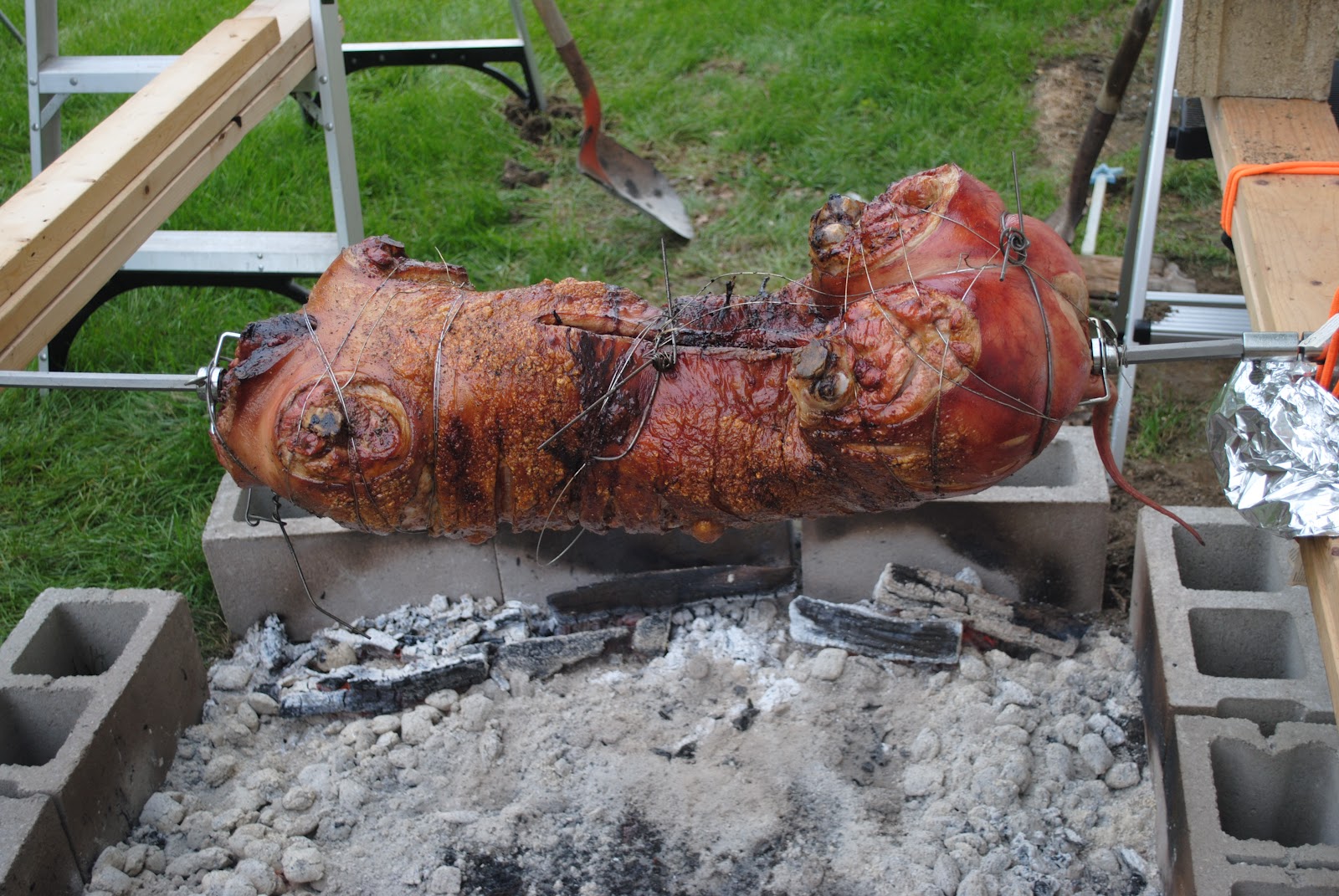
Local pig on a local spit. He wouldn't fit so I had to saw off his local head.

I find that even in circles where many so-called progressive ideas are embraced there is widespread skepticism for what is perceived as the local food movement.

The thrust of such opposition seems to be that if everyone tried to eat exclusively that way, we would all starve. Now, that may well be true. But it does not follow that no one should prefer certain kinds of local food ever. Maybe some people really are advocating the former idea, but I have not met them, and I certainly do not advocate it myself. Nevertheless I do think there are good reasons to prefer local food.

First, freshness. Fresher food tastes better and is better for you. It's easier for fresh food to travel 60 miles and stay fresh than if it travels 6,000 miles. It can be picked later and thus ripen on the vine rather than in a barge.

Second, roots. Eating local gives you some idea of the region you live in, its history and climate and fauna. I now know that great strawberries come from Pennsylvania, while great mangoes do not. That makes me want to eat our strawberries more; when I do so it makes me feel like a Pennsylvanian fed by tradition and my homeland rather than an abstract citizen of the world fed by reductionism and nowhere. Moreover by doing so I continue the collective memory that has existed for generations rather than losing it to a sea of utilitarian pragmatism.

Third, variety. Food produced for global consumption must prioritize hardiness and usually cosmetic factors like color and volume. But smaller-scale production allows for finer-grained choices with different constraints. Tasty heirloom varieties that would never succeed on that stage can be delightfully embraced on the local scale.

Fourth, resilience. The extreme of comparative advantage may be the route to the highest theoretical yield, but there is a tradeoff between optimization and brittleness. A region that produces some of its own food is less subject to the vagaries of the global market. A drought in central Asia or an inexplicable decision by another country to turn its food calories into fuel calories does not change the local tomato yield.

Fifth, accountability. The feedback loop between me and a farmer I buy from, or even that farmer's middleman, is a lot tighter than with the global system. In the latter case I have no chance of affecting any change; in the former I actually have a decent shot.

What makes me sad about knee-jerk anti-local arguments is the grim resignation toward a life of bland drudgery at the dinner table they imply. Whatever the downsides of the global system, it is said, it is the only chance we have of feeding everybody. A world with seven billion and counting people does not have the luxury of participating in the pleasures of traditional food production and consumption. We have already exceeded the global carrying capacity by so much that we must optimize the system as much as possible, or everyone. will. starve.

If that were the case it would be tragic, as tragic as never hearing birdsong again because we took all of their habitats or needing to wear heavy clothes in the summer because we destroyed the ozone layer. It is positively dystopian, and such eventualities should not be blithely accepted. At the least, those who can afford to choose otherwise should be free to.

All of that said, I have yet to participate in the most-local, least-efficient method of food production of all: gardening. Boy would I like to.

Thursday, March 4, 2010

Resonance

Do re mi fa so...

Looking out the window this morning I see that the earth is beginning to resonate.

Let us not be unscientific in our language here. Strictly speaking, resonance occurs when you touch something in just the way it is meant to be touched and it breaks into song.

It has been six months since the sunlight took on the peculiarly golden slant it acquires every September. I know that the earth is only now emerging from the slumber to which that light alluded.

Yet resonance is no gentle phenomenon,* and March is no gentle month. I remember the teaching from kindergarten: even if March comes in like a lamb, you can bet it will go out like a lion.

Therein lies, I wonder, a principle of nature. New life arrives amid violence. April could not be born from February without a tumultuous March, just as babies cannot be born from their mother without labor pains. Positive feedback mechanisms, resonance, are required in order to overthrow the status quo.

Indeed, Paul the Apostle tells us in the passage called the high peak of Scripture that
"the whole creation has been groaning together in the pains of childbirth until now", "in hope that the creation itself will be set free from its bondage to corruption and obtain the freedom of the glory of the children of God." (Romans 8: 22, 20b-21)
Even the freedom of glory which is the final restoration of humanity and of the world will require a tumultuous transition.

I further wonder: what sort of resonance does the human heart display?

* Just ask the Tacoma Narrows Bridge

Wednesday, July 1, 2009

A First Approximation

"You say, 'I don't know how to solve an elephant, but I do know how to solve a mouse.' And so you start with a mouse and build to an elephant."
Dr. Marija Drndic, professor of physics, University of Pennsylvania
I may not have mastered introductory quantum mechanics, but Professor Drndic's words have remained with me. She speaks with regard to problem solving (perturbation theory, to be precise), but I think of them now with respect to travel.

On Sunday I will leave for six weeks in Seoul, South Korea. I have studied Korean. I have some Korean friends. But by no means do I profess to understand Korea.

For the sake of this analogy, let's call Korea the elephant. And let's call Pennsylvania, my home state, the mouse.

Wikipedia affords some comparisons:


So, while Pennsylvania has about 20% more space, in Korea reside almost four times as many people. It's liable to feel a bit crowded over there. Also, to the extent that GDP per capita is a reflection of wealth, your average Pennsylvanian is a little wealthier than your average Korean.

Judging by latitude, climate should be similar, though Korea's peninsular nature and other geographic features should make for differences.

How about each locale's respective largest cities?


Yikes. Like I said, it might feel crowded.

How about a comparison of the depth of history in each place? I remember a conversation with my Korean conversation partner in which I told her the various, mostly European lineages from which I descend. She replied, "My 58th grandfather is Korean."

Hmm. Perhaps statistics will only get me so far.

Sunday, July 13, 2008

Keystone Solution

Gorgeous. The weather isn't bad, either.

Thoughts while I visit California:

In Pennsylvania, weather varies primarily in time. There is stark variation across the four seasons, or across patterns from one week to the next, or even within one day. On many occasions, a look into a clear sky has led me to lock my bike in the open, only to return to it later soaking.

In California, weather varies primarily in space. The part of San Francisco in which I'm vacationing is often covered in thick fog. However, a drive of twenty minutes across the Golden Gate Bridge brings me to sun and another fifteen degrees Fahrenheit in Marin County.

Humans have developed fast and convenient ways of traveling through space. Disappointingly, they have developed no way to travel through time. Surely this is one reason real estate in California is so sought after.

Pennsylvania struggles with losing people, especially college graduates, to the Sunshine Belt. Surely the best way to alleviate this problem would be to invent a time machine.

Governor Rendell? Anyone?

Monday, June 30, 2008

Developments Explained

Red: My home. Purple: My favorite bike route. Yellow: Housing developments.
Made using Google Earth. Click to enlarge.


A lot changes in 18 years.

That's how long I've lived at 63 Ruth Avenue in Phoenixville, Pennsylvania. In the scheme of things, that's no time at all. And yet, look at all of the yellow circles above.

Those circles mark housing developments which have gone up in the time I've lived here. You can see these four all within two miles of my home, with one just beyond my backyard. By convention, these places are named after that which they supplant: "Kimberton Meadows;" "Brimful Farms;" "Foxfield;" "Heritage Place." They are also known as "what's wrong with America."

My ears bristled at the sharp criticism that my friend leighcia, with some help from Jane Jacobs, leveled against the suburbs. Simulating nature? That's not what I learned from all of those bike rides growing up, or from the tall maples and soft moss in my front yard.

I think what leighcia was really addressing, as clarified in the comments section and by her husband Matthew, is not what lies along the purple bike path, but what lies within the yellow circles. Here we are on the same page.

Two questions surround these developments. First, why would anyone build these houses? Second, why would anyone want to live in them?

The explanation to the first question is simple, if unsatisfactory: economies of scale. It's much easier and cheaper for one company to build a lot of nearly identical houses all at once than if each house were to be built to order by its future inhabitants. While that makes economic sense (often the only sense something needs to make for it to happen), it leaves out much of what should go into making a home.

I believe the central flaw lies in that the people designing and building the homes are not, in general, the people who will be living in them. Design ingenuity centers on modularity and ease of construction rather than on quality of final product.

From the point of view of construction workers, since the homes are to be built and never seen again, why take pride in them? Why make anything sturdy, or unique, or (dare I suggest) beautiful? Certainly not for personal credit - that will go to Toll Brothers. It becomes a job to complete, not one to do well.

Blame cannot rest entirely on the builders. They are only in one sense giving people what they want. Going back to my second question then, why would anyone want to live in these houses? I present a hypothesis.

First, the homes are generally expensive, which makes them symbols of status. They carry characteristics that give the appearance of wealth, such as high ceilings and large square footage. This is true regardless of how ugly they are.

So young couples looking to start a family go right for the houses which broadcast that they are already successes. They may not be able to afford them, but is success really something you can afford not to buy?

Since the houses are built at the same time, lots of young couples at the same stage of life flock in at the same time. They bring vehicles which broadcast success and drive around their children who broadcast success. The homogeneity of the neighborhoods becomes homogeneity of the neighbors.

The removal of many differences between people in these developments might sound like a recipe for a close-knit community, but I don't think that is what usually develops. Community breathes through interdependence, but this vision of success is built on independence.

Instead of community then, residents find an individualist conformity. Since everyone pursues the same vision simultaneously, the way to be most successful is to deviate the least from that vision.

This is exemplified in the classic suburb exercise, mowing the lawn. Because of builder demands for house density and buyer demands for near-mansions, few development houses have yards to speak of. Regardless, on Saturdays everyone mows their postage stamps at the same time.

We see then why people build and live in droves of hideous houses. People will take success in whatever package they are told contains it. None of the success signals outlined above require houses to be of any aesthetic quality. So they aren't.

My description of the mentality of those who live in these developments may sound a bit extreme. While I would be reluctant to apply it to individuals whom I know and love, I do think in the aggregate these ideas go a long way toward explaining the four yellow circles around my house.

Saturday, January 12, 2008

Sunsets, not Sushi

View from a farmer's field along my route.

My mom and I were joking the other day about how I'm deadline motivated. She remarked that it's not just that deadlines motivate me to accomplish things; it's that deadlines are the only things which motivate me.

I couldn't really argue with her.

Over the break I've been riding my bike, to fight atrophy and because it's fun. It may not help that I haven't been rising much before noon, but it always seems to be 4:30 before I realize that I would like to go on a bike ride today and I don't have much time before the sun sets. Deadline motivation at its most pervasive.

The upside of such a temperament is, I realized today, I get to see the sunset every time I ride.

Let me tell you, sunsets are not the kind of thing that gets old. In fact, I've found there's an extra layer of wonder to be had in going out and seeing it every day. To see the sun set is one thing. But to see it go down day after day, blazing glory after blazing glory, over any length of time is quite another.

It's astounding that it's always there. It's been rising and setting every day, reaching incomprehensibly long before I was born, and it will keep rising and setting, Lord tarrying, long after I die. And tomorrow evening, whether I'm looking or not, it will be there.

Yeah, yeah, it's cloudy sometimes. Whatever.

I consider it an immense gift that I live only a short bike ride away from a clear view of the horizon. It is one of the great tragedies of living in the city that the views of the heavens are obscured beyond daily remembrance, one reason I think it would be very hard for me to settle there permanently. Sunset in the city? The best that you can usually do is perceive that it's happening out there, somewhere.

It is the same with God. He has been his glorious self since before the foundation of the world, and he'll keep being his glorious self long after these heavens and this earth have passed away. And he's there every day, free for us to behold, whether we're looking or not. And usually, we retreat into enclaves of our own making, content to allow our own structures and our own lights to block him out of our view, freeing us from the need to acknowledge his majesty.

I could go on, but I think it sufficient to say that
The heavens declare the glory of God;
And the firmament shows His handiwork.

Day unto day utters speech,
And night unto night reveals knowledge.
...
In them He has set a tabernacle for the sun,
Which is like a bridegroom coming out of his chamber,
And rejoices like a strong man to run its race.

Its rising is from one end of the heaven,
And its circuit to the other end;
And there is nothing hidden from its heat.
Psalm 19:1-2,4b-6