New media have nearly-limitless time-wasting potential. How do we rein it in?
Time is wasted when we get distracted from our purpose or when we have no purpose to begin with. This happens when we go to new media with open-ended questions or impulses. For example, if I want to know "what's on TV," I am signing up for a meandering journey with the remote that could consume any amount of time. And if I sit down at the computer because I am feeling lonely and it offers various products vaguely resembling the company of others, once again I could be in for a long, ultimately-unsatisfying ride.
Purposefulness in approaching these media can go a long way toward reaping the best things they promise without becoming enslaved to the worst of their possibilities. If I go to the TV to watch game 3 of the National League Championship Series, my commitment has definite bounds I am able to evaluate before choosing to engage. If I go to my computer to answer three different e-mails, there is a better chance that I will accomplish exactly what I set out to than if I just open the lid of my computer and see where it takes me.
Note that such thoughtfulness is not nearly so imperative when using older media. There are not too many ways to get tripped up when reading a book. You may read for longer than you intend, but you are still completing a task you knew you wanted to complete at some point. But in general the newer the medium, the better it is at presenting appealing distractions. Media providers make more money the longer consumers are engaged, and so they have made engaging consumers into something of a science.
For instance, last week I signed up for a trial streaming subscription of Netflix. I thought of doing so as gaining access to a library of movies and TV shows. But it was clear that Netflix thought of itself as something more than that. Right off the bat it wanted me to give it some examples of works I liked. It also wanted me to plug in a facebook account so it could tell me what my friends were watching and vice versa. Moreover after everything I watched it asked me in prominent type to rate what I had seen, the better to know the profile of my tastes. Perhaps most subtly and impressively, after one installment of a series started rolling the credits it gave no more than than fifteen seconds before going straight into the next.
So the system is constantly priming itself to dig out new things its consumers will like, and it is actually more work to stop watching than it is to continue. Netflix clearly intends to be more than a library that passively waits to be accessed. Rather it aspires to be a constant stream of entertainment freeing users to think as little as possible in order to be engaged for as long as possible.
For those who aspire to nothing more than enjoyment, that kind of service is an incredible innovation well worth the modest monthly fee. But for those seeking to use new media for their own bidding in larger pursuit of the good, the true, and the beautiful, discipline is paramount.
Know the questions you seek to answer before sitting down. Answer them, and then stand up.
Showing posts with label technology. Show all posts
Showing posts with label technology. Show all posts
Tuesday, October 15, 2013


Wednesday, October 2, 2013
Play it Again, Joe West

Humans watching humans playing a human sport.
I am a baseball conservative and a baseball purist. My positions are two-dimensional and trivial to guess. I hate the designated hitter and I do not think Barry Bonds deserves to go to the Hall of Fame.
I do not apologize for my simplicity, for the baseball diamond is two-dimensional as well. Unlike any other sport in America we look to baseball for the simplicity, naivete, and innocence elsewhere celebrated only in childhood. Therefore I believe my perspective is warranted.
There is another issue against which I am predictably knee-jerk. This issue is that of instant replay. In recent years baseball has started to follow football, tennis, and others in admitting the use of instant replay to determine "what really happened." So far it has only been admitted in one limited, high-leverage situation: the question of whether a home run was really a home run or not. But starting next year the use of replay will likely expand, and one assumes in the future it will expand some more.
I hate instant replay. I hate it even more than I hate blown calls by umpires. But its advent is hardly surprising given the zeitgeist.
How often have I heard the complaint that ours is an overly litigious society. Well, a challenge by a team's manager to a call is effectively a lawsuit. This is a qualitative difference from the old state of affairs in which the manager could come out and kick up a cloud of dust shouting his face Phillies red, but the call as called would stand immutable. With every challenge we bring the weariness of the courtroom onto the ballfield.
Second, ours is an age that highly prizes empirically-determined objectivity. The subjectivity housed in an umpire arbitrarily bestowed with authority does not withstand for one second the scrutiny of our sensibilities. Cameras are supposedly objective, despite the fact that multiple cameras positioned at different angles frequently imply contradictory conclusions and the fact that video must be interpreted by an observer subject to the same quandaries of authority and subjectivity. At any rate, replay certainly gives us collectively more confidence that we all know "what really happened," and that the ruling in the game reflects that consensus. That confidence is what we are looking for.
Finally, ours is an age that ironically verges on the misanthropic. Previous generations may have had a low view of humanity because of the Doctrine of Sin. This idea was tempered by the idea that humanity was made in the Image of God, and God so loved the World, and so forth. Current generations have a low view of humanity because of computers, and this lowness is not tempered but rather reinforced by a materialistic understanding of evolution. Gary Kasparov's defeat at the no-hands of Deep Blue was only the tip of the iceberg. We refer to "humans" not as noble dust animated by the spark of Divinity, but as a shorthand for members of the species homo sapiens.
Just look at Wikipedia. The entire thing is written to be species-neutral, a ridiculous charade given that all of its readers are human. The page for "Human" ought not begin with, "Humans (variously Homo sapiens and Homo sapiens sapiens) are primates of the family Hominidae, and the only extant species of the genus Homo..." but rather with, "You are a human, stupid!"
Without intending to the encyclopedia literally addresses the superior machine intelligence we expect will succeed us in our office as King of Terra Firma. We see no reason why it shouldn't! We agree that evolution has left us with all kinds of quirks that just aren't rational and all kinds of weaknesses that we can engineer a better solution to. We pave the way for our own obsolescence, not just in the realm of engineering but also in the realm of philosophy.
Let the machines officiate over machine sports. I will take the ignorant, loud, biased, ornery, and overweight umpire over them any day. I come to baseball to acknowledge, experience, and celebrate my humanity. I do not need it to kick me back into the dust.
Monday, November 12, 2012
Getting Around
One of the most general critiques of technologies is that as we come to rely on them, we become more helpless when they fail or we find oursleves without them.
One of the easiest examples is the technology of GPS. With a GPS one is largely spared the burden of ever being lost. The tradeoff is that if one is not careful, one will also lose the joy of knowing one's way around.
I had a stark experience of this downside recently. I was at the doctor's office and I was going next to a third-party facility for routine bloodwork.
Not remembering exactly how far down the road the facility was, I asked the check-out woman for directions. This woman was probably in her sixties and so she has certainly had to get around for many years before GPS was widely available. Nevertheless, she first appeared flustered, then asked if I had a GPS I could enter an address into. I did, so she handed me a flyer with the address circled on it and sent me on my way.
The thing was as I discovered momentarily the place was on the same street a mere two traffic lights farther down. To have entered the address into my phone and waited for it to tell me to go a thousand feet before turning left would have been quite the opposite of thinking.
But that's just the point. With GPS we have essentially outsourced the problem of navigation from our brains to our computers. That has obvious benefits, but the cost of not being able to distinguish simple cases from complex ones or of not building a mental map of our surroundings at all are significant. It is also apparent from this example that just as muscles atrophy from idleness, we can lose faculties we once possessed. I guarantee that twenty years ago that woman could have told me to go down the street two lights and turn left.
The implication is not that GPS is a bad thing that shouldn't be used. Rather, we should be critical in our use of it. I prefer to use it more like a compass, giving me an idea of a route before I set out on a trip and then going back to it if I stray or become uncertain. In the meantime I do my best to follow along with the route, to know where I am and where I am going. Additionally, if I am giving directions, along with just giving an address to be plugged into a computer, to those that will hear it I give an overview of the way.
On a recent trip to San Francisco I was quite gratified to know enough of my way around to be guiding other visitors and driving them around town. I felt like I had more ownership of the place I was visiting and that I understood more what makes it tick. And on a recent trip to Washington D.C. after giving an address to a friend I was glad I called him back and told him the simple directions. As a result I had a stake in his journey and our shared experience started as soon as he left. I felt like we had acheived something special in this day and age.
In both locations I used my phone as a GPS quite frequently. But I feel I was much more its master than it mine. Let us likewise wield all of our tools.
Wednesday, August 22, 2012
Locavore
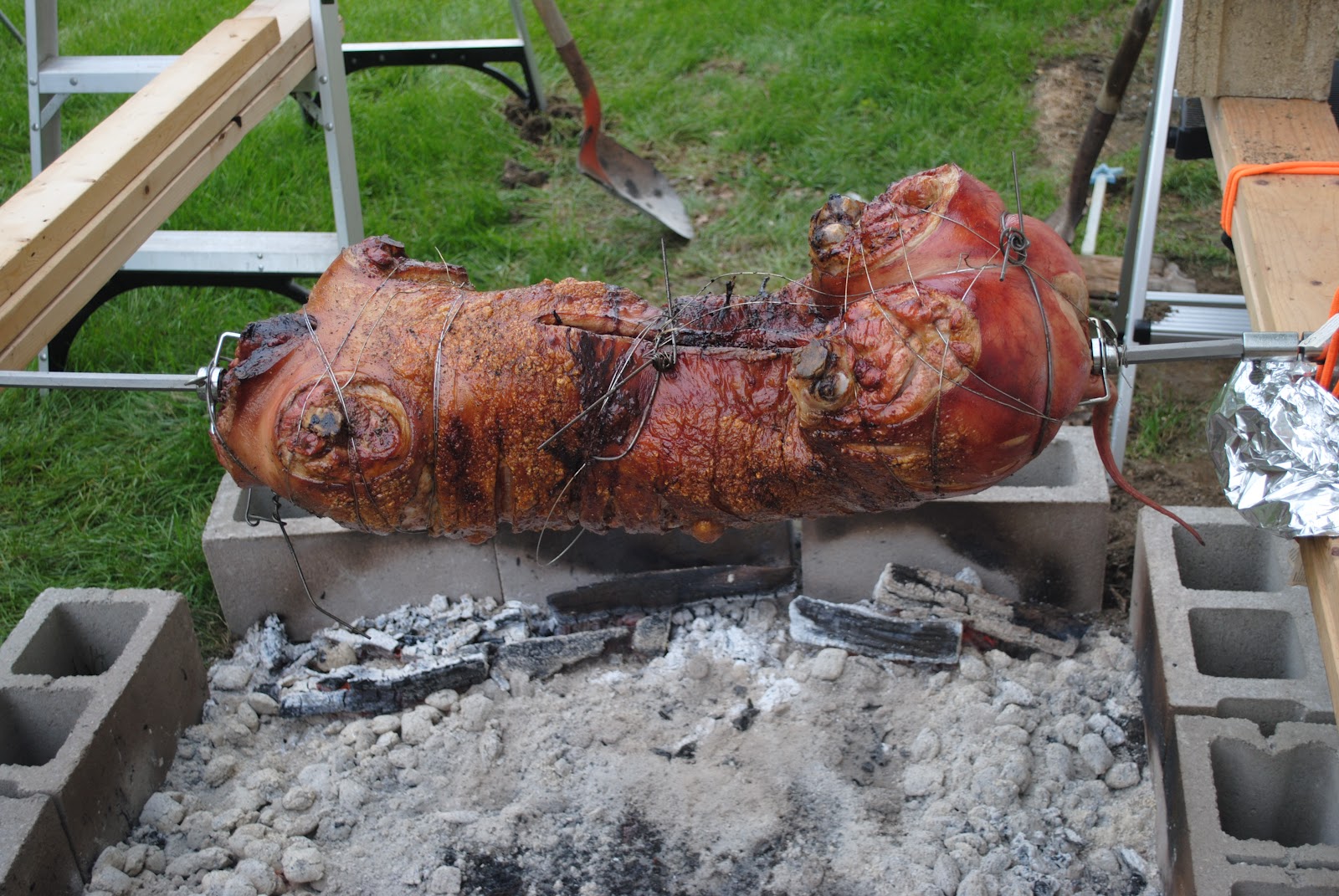 |
| Local pig on a local spit. He wouldn't fit so I had to saw off his local head. |
I find that even in circles where many so-called progressive ideas are embraced there is widespread skepticism for what is perceived as the local food movement.
The thrust of such opposition seems to be that if everyone tried to eat exclusively that way, we would all starve. Now, that may well be true. But it does not follow that no one should prefer certain kinds of local food ever. Maybe some people really are advocating the former idea, but I have not met them, and I certainly do not advocate it myself. Nevertheless I do think there are good reasons to prefer local food.
First, freshness. Fresher food tastes better and is better for you. It's easier for fresh food to travel 60 miles and stay fresh than if it travels 6,000 miles. It can be picked later and thus ripen on the vine rather than in a barge.
Second, roots. Eating local gives you some idea of the region you live in, its history and climate and fauna. I now know that great strawberries come from Pennsylvania, while great mangoes do not. That makes me want to eat our strawberries more; when I do so it makes me feel like a Pennsylvanian fed by tradition and my homeland rather than an abstract citizen of the world fed by reductionism and nowhere. Moreover by doing so I continue the collective memory that has existed for generations rather than losing it to a sea of utilitarian pragmatism.
Third, variety. Food produced for global consumption must prioritize hardiness and usually cosmetic factors like color and volume. But smaller-scale production allows for finer-grained choices with different constraints. Tasty heirloom varieties that would never succeed on that stage can be delightfully embraced on the local scale.
Fourth, resilience. The extreme of comparative advantage may be the route to the highest theoretical yield, but there is a tradeoff between optimization and brittleness. A region that produces some of its own food is less subject to the vagaries of the global market. A drought in central Asia or an inexplicable decision by another country to turn its food calories into fuel calories does not change the local tomato yield.
Fifth, accountability. The feedback loop between me and a farmer I buy from, or even that farmer's middleman, is a lot tighter than with the global system. In the latter case I have no chance of affecting any change; in the former I actually have a decent shot.
What makes me sad about knee-jerk anti-local arguments is the grim resignation toward a life of bland drudgery at the dinner table they imply. Whatever the downsides of the global system, it is said, it is the only chance we have of feeding everybody. A world with seven billion and counting people does not have the luxury of participating in the pleasures of traditional food production and consumption. We have already exceeded the global carrying capacity by so much that we must optimize the system as much as possible, or everyone. will. starve.
If that were the case it would be tragic, as tragic as never hearing birdsong again because we took all of their habitats or needing to wear heavy clothes in the summer because we destroyed the ozone layer. It is positively dystopian, and such eventualities should not be blithely accepted. At the least, those who can afford to choose otherwise should be free to.
All of that said, I have yet to participate in the most-local, least-efficient method of food production of all: gardening. Boy would I like to.
Monday, June 25, 2012
Stop worrying and love the road.

It helped that we took a scenic route, driving through Delaware and the Delmarva Peninsula across the Chesapeake Bay Bridge-Tunnel (it's both!) through Virginia Beach. It was beautiful countryside on a textbook June day. It helped too that the best of those things were on display. The Wawa folks knocked it out of the park with the breakfast burrito; it was all of the sensual gratification and visceral satisfaction that fast food aspires to be. And the road trip is the automobile at its best. I felt real camaraderie with the stranger in the BMW who for thirty miles wove with me past and around traffic that seemed to know nothing of the "drive right, pass left" principle.
Something else was at play though. A big reason the road trip was so enjoyable was the peace that came from living for one day as an American and not as an individual. I did what I was supposed to do, and what I was supposed to do was drive. For a century this ritual pilgrimage to wherever has been more American than apple pie, unless that apple pie was served at a McDonald's drive through. Taking part in it made me feel like a properly turning gear in a precisely tuned clock.
I felt this peace most acutely at a rest stop in Delaware. After getting out of the car I paused to take in the well-groomed lawn and the 1950's classic cars that were trundling into the parking lot at that moment. I continued in past a procession of vending machines each tempting me with a different variety of saccharine, preserved, and caffeinated satisfaction. The bathroom experience with its automatic flushes and antibacterial hand foam could not have been more tranquil if I had been brought through on a conveyor belt. On the way out I paused again to smell the tiger lilies ringing a spurting fountain.
At no point was there any doubt what I was supposed to be doing. I with all others present fulfilled my calling. We sustained America and thus were Americans together. That felt good.
Sunday, May 27, 2012
Muse Sick
For Jonathan.
Is it a good thing or a bad thing that we can record music? Meaning, on balance, are we better or worse off because we have this capability?
It is hard for me to answer that question because I do not know much about what it was like before recording, and it is impossible to picture a world in which all else is the same but for the absence of this one technology. Nevertheless, I think the question is worth asking.
My life has been changed in the last year by my purchase of a high quality set of headphones. I have always spent much of the time at my work computer listening to music, but since getting these headphones the music has started affecting me more. I find the music more moving. It stays in my head longer. I think about it more when I am not listening to it. And for the first time in my life I have actively sought out new music myself rather than just picking up what friends and family pass along. Finally, I have felt that I cannot only listen to music, but that I ought to make some myself. This summer I intend to take up the mandolin.
While those effects are dramatic, the explanation is simple. Recordings have not changed, but the way I listen to them has. I am hearing the music now and I was not hearing it well before. The music is at its core beautiful and wonderful, even divine. It is right that it should awaken latent passions and imaginations within me. But it could not do so beforehand because its nature was lost in transmission through inferior sound equipment.
It goes without saying then that I am very glad for the recordings that I have. Through them I have a richer understanding of what music can be. If there is a downside to our ability to make recordings, it is not that it is impossible to richly appreciate music through them. The problem is that it is far easier to brutalize and cheapen music through recording technology.
Most people do not listen to music on good headphones or speakers. In fact, with the proliferation of portable electronic devices in the last ten years, there are more and more speakers, the large majority of which are low quality. That is because the push has been for these devices to be more portable with a minimalist aesthetic. It is a matter of physics that good speakers cannot be made at the dimensions and power requirements of laptop speakers. Inexpensive earbuds and headphones are likewise of poor quality despite increasing ubiquity.
People listen to music more now than ever before, but it is uniformly crappy, even controlling for tastes. I have been shocked to see kids on buses listening to music as blared from their phones' speakers. It is not primarily that I would not listen to the songs they are playing (though I would not), but that I could not believe listening to music on those speakers was better than silence.
Are we better off with a little of something great, or a lot of a cheapened version of that thing? America has consistently chosen the latter. Are we better off with a lot of something great, or a lot of a cheapened version of that thing? Even when this is the choice we face, too often the default, cheap version is uncritically accepted.
There are other consequences of the widespread use and availability of recording technology. Doubtless our very idea of what music is has changed. Most commercially successful music could never be performed. Recordings are built from fundamental parts and then mixed and processed into a polished whole. It is the same difference as that between a stage play and a film. Human imagination is cut loose from physical constraints. A wholly unremarkable performer can be transformed into a top-20 hit by this artifice, and to ears accustomed to such music, that which can actually be performed sounds unremarkable.
As a result of this inversion, music is elite. People have as much chance of producing successful music as they have of making it in Major League Baseball or in Hollywood, and the ability to succeed in that sphere only marginally follows from talent.
Thankfully, music which is less "popular" is more accessible. Moreover the Internet has disrupted the hegemony of recording monoliths, and for those interested in something different there are abundant alternatives. But such choices remain off the beaten path.
In sum, recordings make excellent music widely available and producible on demand, but for most people music is ever-present and low-quality, and music itself exists only in "recordings" of impossible performances.
As a result are we better or worse off? For me the glory of music is inextricable from performance. It is a mystery that the very possibility of music is hidden and encoded within the laws of physics and of human biology, and it only comes to being through the interplay of human creativity with physical instruments. To me the decoupling of these two represents not the triumph of creativity over physics but the loss of what makes music music. Moreover there is further joy to be had in the production of music and in the shared experience of performer and audience. That this kind of experience has been rendered rare and perceived as elite is likewise to be lamented.
While it need not be this way, I think on balance we are worse off.
Monday, July 25, 2011
The World Must Be Peopled
"The World Must Be Peopled." Such was my favorite line from William Shakespeare's Much Ado About Nothing, which I witnessed for the second consecutive night this evening in Clark Park.
"Shakespeare in Clark Park," having now for a sixth consecutive year provided free performances of the works of he who commanded English like no other man has, is becoming an institution in these parts. It is positively delightful to sit out on the grass in the lovely July sunset with the whole community, being challenged by art which is higher than our faculties rather than being sedated by entertainment that indulges our baser cravings, being shown a portrait of the good life entirely different from that which bombards us in most of our lives.
The experience could be a springboard for several themes with which I have been occupied, but I would like to return to the question of Community v. Network as discussed in my previous blog post, more specifically the related question of Past v. Present.
As is a constant delight to me, dear brothers Jonathan and Ben responded with thoughtful challenges to my views. I hope that we may continue to pursue the truth together, even over this great network and on this ethereal forum, not simply for conversation as an end in itself, but for the discovery of an idea of the good life (that is, the life worth aspiring to and fighting for) greater than either Shakespeare or we have known.
In order to return to this question, let us pause a moment and examine exactly what Shakespeare presents to us in this play. Much Ado is a comedy, and therefore presents something like life in the ideal: life in which the designs of evil may cast a dark shadow, but a shadow that ultimately flees before the light. At the end all is well.
As Shakespeare presents, "all" being "well" is characterized chiefly by a right ordering of human relationships. For him to say so requires saying first off that there is a right ordering, and consequently that there are wrong orderings as well. Contrary to Benedict and Beatrice's early avowals, it is right that they marry, and it would have been wrong if they did not. The estate of Beatrice's father must be carried forward after he dies; Benedict cannot happily remain a bachelor forever, nor Beatrice a maid; the world must be peopled.
Moreover, it was right that Hero should have known no man when she married Claudio. Had the accusation against her not been false, it would have been right that she should be ashamed; in such a situation her father went so far as to say:
That I am in favor of an objective and received order over a subjective and created one, and that the order I believe would better make for peace, happiness, truth, and meaning resembles in many respects the one I have described here, is somewhat beside the point I wish to make. Rather, I would like to ask that we engage the question of the good life critically, rationally, and earnestly, with humility toward the past.
I want to emphasize humility toward the past. It is common to hear easy dismissals of past social orders. But I do not think that most who do so have done the intellectual heavy lifting required to make such statements. In essence, I do not believe they make the effort to understand that which they reject, nor do I believe they claim to.
I can think of two reasons why not. First, doing so is work, and there are many pursuits worthy of work. Second, doing so is unnecessary, because we are fundamentally different than those who lived in the past.
I will address the latter impulse before the former. C.S. Lewis called it chronological snobbery. I believe it stems in part from an idea of social progress that comes from the demonstrated reality of technological progress. The story goes something like this: People twenty years ago did not have the Internet, people seventy years ago did not have television, and people a hundred twenty years ago did not have electricity. Likewise, a hundred years ago women were not allowed to vote and what we now call racism was entrenched and accepted.
It is easy and natural to look at such a picture, which is stark and obvious, and to conclude that just as our technological advances have built on all of the best from our predecessors, so too have our social ideas advanced. We even have an idea of an abstract concept of a "civil rights movement," in which a society slowly becomes aware of a grave injustice in its order due to a minority courageously standing for the truth. I do not know how many times I have heard that such and such issue is "the Civil Rights issue of our time." Such an idea is an analog to the scientific method. It is an idea about how to make progress at a faster rate than it has been made in the past.
While the position that social progress is inevitable and self-advancing is completely natural given a naive presentation of contemporary life, it is overly simplistic. Unlike scientific knowledge, social knowledge does not automatically distill itself over time; that which is wrong is not naturally and inevitably corrected by that which is right. Rather, societies may regress as well as progress. Different ages may be peculiarly prescient, and they may also be peculiarly blind. That statement goes for the past, and it also goes for the present.
If true, we are brought more concretely back to the first objection to thinking about the past: it is hard work. If our age does not have a privileged moral position in the social realm, then the legitimacy of the claims of all other ages might seem to leave us in the midst of an indecipherable cacophany.
While I believe we may receive guidance from the past on how to make sense of the past, I will not dispute that we are left with a very difficult task. But I will assert that doing that work is not as hard as collectively going it alone, of soldiering into the terrifying future with nothing about us but our own wits. I will also assert that buried not so deeply in the sands of time are treasures of such richness that were we to possess them we would not think of questioning whether the manual work of digging was worth the opportunity cost. Luke Skywalker was better able to meet the foe with his father's lightsaber, and Frodo Baggins could not have faced Shelob without the light of an ancient star. We do well to carry with us the wisdom of our forebears.
Finally, I would like to respond to Jonathan's comment by acknolwedging the nonexistence of the kind of ideal past presented in Shakespeare's play. No people has ever built the just society or realized the rightness of all human relationships. But we in our time have considerably better heuristics available to us than "change is good" or "change is bad." In fact, thanks to technological advances, we may be better suited than any people has been to intelligently evaluate the past.
Let us set about the good work together. The future needs the past, and if we do not uncover it I do not know who will.
"Shakespeare in Clark Park," having now for a sixth consecutive year provided free performances of the works of he who commanded English like no other man has, is becoming an institution in these parts. It is positively delightful to sit out on the grass in the lovely July sunset with the whole community, being challenged by art which is higher than our faculties rather than being sedated by entertainment that indulges our baser cravings, being shown a portrait of the good life entirely different from that which bombards us in most of our lives.
The experience could be a springboard for several themes with which I have been occupied, but I would like to return to the question of Community v. Network as discussed in my previous blog post, more specifically the related question of Past v. Present.
As is a constant delight to me, dear brothers Jonathan and Ben responded with thoughtful challenges to my views. I hope that we may continue to pursue the truth together, even over this great network and on this ethereal forum, not simply for conversation as an end in itself, but for the discovery of an idea of the good life (that is, the life worth aspiring to and fighting for) greater than either Shakespeare or we have known.
In order to return to this question, let us pause a moment and examine exactly what Shakespeare presents to us in this play. Much Ado is a comedy, and therefore presents something like life in the ideal: life in which the designs of evil may cast a dark shadow, but a shadow that ultimately flees before the light. At the end all is well.
As Shakespeare presents, "all" being "well" is characterized chiefly by a right ordering of human relationships. For him to say so requires saying first off that there is a right ordering, and consequently that there are wrong orderings as well. Contrary to Benedict and Beatrice's early avowals, it is right that they marry, and it would have been wrong if they did not. The estate of Beatrice's father must be carried forward after he dies; Benedict cannot happily remain a bachelor forever, nor Beatrice a maid; the world must be peopled.
Moreover, it was right that Hero should have known no man when she married Claudio. Had the accusation against her not been false, it would have been right that she should be ashamed; in such a situation her father went so far as to say:
O Fate! take not away thy heavy hand.If we take Shakespeare seriously, we are presented with a double offense. The obvious offense is the content of the moral order here presented, which in our day has been rejected in nearly every respect. But before we arrive at the content of that order, we are first offended that there should even be such an order, objective and received, rather than subjective and created.
Death is the fairest cover for her shame
That may be wish'd for.
That I am in favor of an objective and received order over a subjective and created one, and that the order I believe would better make for peace, happiness, truth, and meaning resembles in many respects the one I have described here, is somewhat beside the point I wish to make. Rather, I would like to ask that we engage the question of the good life critically, rationally, and earnestly, with humility toward the past.
I want to emphasize humility toward the past. It is common to hear easy dismissals of past social orders. But I do not think that most who do so have done the intellectual heavy lifting required to make such statements. In essence, I do not believe they make the effort to understand that which they reject, nor do I believe they claim to.
I can think of two reasons why not. First, doing so is work, and there are many pursuits worthy of work. Second, doing so is unnecessary, because we are fundamentally different than those who lived in the past.
I will address the latter impulse before the former. C.S. Lewis called it chronological snobbery. I believe it stems in part from an idea of social progress that comes from the demonstrated reality of technological progress. The story goes something like this: People twenty years ago did not have the Internet, people seventy years ago did not have television, and people a hundred twenty years ago did not have electricity. Likewise, a hundred years ago women were not allowed to vote and what we now call racism was entrenched and accepted.
It is easy and natural to look at such a picture, which is stark and obvious, and to conclude that just as our technological advances have built on all of the best from our predecessors, so too have our social ideas advanced. We even have an idea of an abstract concept of a "civil rights movement," in which a society slowly becomes aware of a grave injustice in its order due to a minority courageously standing for the truth. I do not know how many times I have heard that such and such issue is "the Civil Rights issue of our time." Such an idea is an analog to the scientific method. It is an idea about how to make progress at a faster rate than it has been made in the past.
While the position that social progress is inevitable and self-advancing is completely natural given a naive presentation of contemporary life, it is overly simplistic. Unlike scientific knowledge, social knowledge does not automatically distill itself over time; that which is wrong is not naturally and inevitably corrected by that which is right. Rather, societies may regress as well as progress. Different ages may be peculiarly prescient, and they may also be peculiarly blind. That statement goes for the past, and it also goes for the present.
If true, we are brought more concretely back to the first objection to thinking about the past: it is hard work. If our age does not have a privileged moral position in the social realm, then the legitimacy of the claims of all other ages might seem to leave us in the midst of an indecipherable cacophany.
While I believe we may receive guidance from the past on how to make sense of the past, I will not dispute that we are left with a very difficult task. But I will assert that doing that work is not as hard as collectively going it alone, of soldiering into the terrifying future with nothing about us but our own wits. I will also assert that buried not so deeply in the sands of time are treasures of such richness that were we to possess them we would not think of questioning whether the manual work of digging was worth the opportunity cost. Luke Skywalker was better able to meet the foe with his father's lightsaber, and Frodo Baggins could not have faced Shelob without the light of an ancient star. We do well to carry with us the wisdom of our forebears.
Finally, I would like to respond to Jonathan's comment by acknolwedging the nonexistence of the kind of ideal past presented in Shakespeare's play. No people has ever built the just society or realized the rightness of all human relationships. But we in our time have considerably better heuristics available to us than "change is good" or "change is bad." In fact, thanks to technological advances, we may be better suited than any people has been to intelligently evaluate the past.
Let us set about the good work together. The future needs the past, and if we do not uncover it I do not know who will.
Wednesday, June 29, 2011
Communities and Networks
I wonder if the word "community" has become abused.
I am no etymologist, but I believe the original notion of the word refers both to a place and to the people who live in that place. My hometown of Phoenixville and those who live there constitute a community.
People in a community have in common that which pertains to their place, including a particular history and particular ways of life foisted upon them by their shared circumstance. Beyond that commonality, people in a community differ in many ways, but in the traditional sense they are more or less stuck with each other, and they must learn to get along. Healthy community life is a story of unity and diversity, running in both directions.
I fear this concept is more or less antiquated. One reason is that people are not tied as much to one place as they used to be. To give a simple example, my father was born in and died in Phoenixville Hospital. Rest assured, I will not be caught dead in my birthplace of Silver Spring, MD.
Along with this increased mobility, in many places there is no there to begin with, to paraphrase Gertrude Stein. In large swaths of the country (including Silver Spring, MD) people are to get where they are going quickly in hermetically sealed containers, with destinations more or less indistinguishable from one another. People in such places are not forced into life with one another, and there are few distinguishing features around which they could build a distinct local identity anyway.
That it is very difficult in the midst of such social forces to keep from becoming alienated from one another and from nature, few will dispute. Indeed, a proliferation of technologies have stepped into the void. Such technologies promise to help us stay connected to those whom we love but who are far off, as well as to forge new and enriching connections.
Whatever the worth of these substitutes, it is important to main the distinction between them and this same idea of a community. They are not communities but networks; not agglomerations of disparate people in a particular place, but organizations of unified people in no particular place. To confuse them as such is to overlook fundamental truths about how human beings are meant to live.
Networks are suitable for organizing people for collective action, for communication about the mission of the group, and to some extent for the exchange of ideas. But they fail utterly at providing meaningful human connection. To take the most basic human relationship, friendship cannot be sustained across a mere network. Through a network it may be kept in stasis for a time, but if a connection is meaningful it will always converge toward life shared in person.
I doubt that these points about networks are very controversial, and yet as the exponentially advancing tide of technological growth drives us into ever more atomized existence, I do not see many making the hard life choices that could make for healthy life in a community. To be honest, I am not even sure how people could do so, short of dropping off of the grid and moving into an agricultural commune. I am by no means exempt from this criticism. I spend in excess of forty hours per week in front of a computer with people with whom I have no stake outside of the workplace, and I spend scarecly four hours per week collectively with those with whom I ostensibly have the closest connections.
Networks are not bad things. In general, I would say they are very good. But they are not communities, nor can they substitute for them. If we intend to preserve a civilization in which people can have meaningful life together, we will have to work very hard, and I suspect we will not receive much help from technology or from the voices of the world.
Sunday, January 2, 2011
The Weight of Futility

Cynicism, sarcasm, and a mode of detached indifference called "being ironic" have become the dominant posture through which my generation interacts with the world. This trend likely has deep roots, at least as deep as Bart Simpson, but I believe it has intensified in even the last five years. You could point to a lot of reasons, but a major one has got to be the continued emergence of electronic technologies.
These technologies are supposed to enrich our lives by making more accessible modes of expression that previously required a lot more money and expertise. My dad once told me about the painstaking work of splicing together 35mm film in the editing process when he was a teenager. A method like that required a lot more time and care than any of the free digital video editing programs out there, and professional or semiprofessional packages are not much harder to reach.
Making processes like video editing or photography or publishing easier and more accessible seems like a slam dunk, but one drawback is that the ease of producing the form of the medium can mask the absence of meaningful content. Any idiot can make a coherent movie now, but that doesn't mean that idiot has something worthwhile to say. The result is a saturation of media in which whatever is significant is buried among mountains of inanity.
I feel this malaise when I take pictures with the ridiculously affordable SLR I bought last May. Walking on the beach in Santa Cruz, California the other day I wanted to take a picture of the view looking down the coast at the reflection of sunlight off the ocean. Instantly I was awash in existential angst. First, in the world there are much more beautiful beaches at much more appealing seasons than Santa Cruz in late December. Second, I do not know how to make good use of my camera, and even if I did I am sure there is equipment which would improve the final product.
The connection of everything with everything means my photo could only be evaluated in the context of photographs of tropical beaches done by professionals the world over. Yet because everyone has seen so many of those pictures, even they elicit scarcely a neuron excitation in the brain. To even take the picture seemed a preposterous conceit, like a droplet of water aspiring to become an ocean wave and inevitably collapsing into an inconsequential eddy.
In a climate of such media ubiquity, it is easy to despair of saying anything original or meaningful. Whatever could be said has probably been said already a hundred thousand times, and probably more competently and expressively at that. At the same time, access to all of those prior expressions makes them essentially insignificant themselves.
The resulting world is one in which it seems there is nothing new to say, and in which that which has been said has demonstrably fallen short of the Ultimate. How could anyone interact with such a world, except through sarcasm, indifference, and cynicism? To do so is simply to bow to the crushing weight of futility.
Saturday, September 4, 2010
Authenticity Revisited
My last post was entitled "Authenticity," yet the word authenticity was nowhere to be found within the message itself. Jonathan called my vagueness to attention and asked for clarification, asking, "Is your complaint here authenticity, or is it quality?"
Indeed, my use of the word begs a definition. I omitted one previously because I could not articulate what I meant, and I hoped that it would be demonstrated by the examples I mentioned. Fortunately, a 17-hour drive to Chicago with Jonathan gave me plenty of time to hash it out.
One observation I had was that before lower-quality versions of the commodities I mentioned existed, no qualifying adjective was needed to describe them. For example, before factory farming methods, eggs did not need to be designated as "pastured" because all eggs were what we now call pastured. The very proliferation of words designating levels of quality betrayed to me a confusion about authenticity resulting from whatever "consumer choice" and "freedom" were won in the process.
Another aspect which puzzled me was the artisan's pursuit of consistency versus the factory's guarantee of standardization. To explain, I will first allow Jeffrey Hamelman from my wonderful bread book to define what I mean by an artisan:
Here my conundrum presents itself. If consistency is the only value, factories are much better than artisans. With a combination of standardized and interchangeable human and machine labor, they are able to produce nearly identical output. For example, if you have had one Oreo, you have had them all, because they are all the same to an impressive degree. If the best artisans are the most consistent, then are not machines far better than the best artisans?
Intuitively I knew this proposition was false. I realized the crucial difference is uniqueness. Because an Oreo is an Oreo is an Oreo, there is actually no such thing as an Oreo. There is only Oreo, an abstract concept with no particular incarnation. Oreo carries no attachment to anything real, actual, or particular, but only to Nabisco, itself a faceless, rootless, and soulless subsidiary of a multinational corporation.
By contrast, the work of an artisan contains within it something of the artisan himself. I know when I cook that I like very strong flavors with lots of heat. This preference is in accordance with my personality, and so when you eat my food you come to know me in it. Hamelman speaks of a particular day's bread being memorable and charismatic, two things which could never be said of one instance of a standardized product compared to another.
I posit then that authenticity bespeaks two derivative qualities. The first is adherence to objective standards of quality, the same for all instances of the thing produced. The second is specificity, both in that each instance may be distinguished from other instances and thus has its own identity, and that each instance represents the identity of its author.
Factory-produced items may in principle be high quality, but they cannot be authentic. For one, when many contribute to the process, such as when a baking operation is carried out by men who mix separate from men who shape separate from men who bake, the result contains not all of their identities but none of them. For two, factory processes depend on the standardization of every task, depending on no particular man to accomplish them and so by design carry no specificity.
In this way authentic work is like humanity itself. Humans all meet the objective standard of the image of God, yet each is a completely unique work which individually displays the characteristics of his or her creator. It only makes sense that when humans represent the best of their God-given and God-like nature, they create in the same manner as he does.
Indeed, my use of the word begs a definition. I omitted one previously because I could not articulate what I meant, and I hoped that it would be demonstrated by the examples I mentioned. Fortunately, a 17-hour drive to Chicago with Jonathan gave me plenty of time to hash it out.
One observation I had was that before lower-quality versions of the commodities I mentioned existed, no qualifying adjective was needed to describe them. For example, before factory farming methods, eggs did not need to be designated as "pastured" because all eggs were what we now call pastured. The very proliferation of words designating levels of quality betrayed to me a confusion about authenticity resulting from whatever "consumer choice" and "freedom" were won in the process.
Another aspect which puzzled me was the artisan's pursuit of consistency versus the factory's guarantee of standardization. To explain, I will first allow Jeffrey Hamelman from my wonderful bread book to define what I mean by an artisan:
"These days artisan and baker are often combined into one term, as if the unadorned noun baker needs further enhancement...The skilled baker, working with his hands, doing the same work each day, takes his place with the artisans of history...The baker, each day, tries to perfect something that was worked out hundreds of years ago. Mastering the art of fermentation is the ultimate aspiration of the bread baker...When it all goes just right (which it rarely does), and the day's breads have attained more than just good taste, but are, for that day, memorable and charismatic, then the baker knows again why he sets his alarm for that challenging hour."So an artisan pursues every day the same objective, unchanging standards of perfection, while usually falling short. The best bakers are those who most consistently navigate all of the vagaries of humidity, flour quality, and dough temperature et al (the list is quite long) to produce results close to the standards of their craft.
Bread, Jeffrey Hamelman, John Wiley & Sons 2004.
Here my conundrum presents itself. If consistency is the only value, factories are much better than artisans. With a combination of standardized and interchangeable human and machine labor, they are able to produce nearly identical output. For example, if you have had one Oreo, you have had them all, because they are all the same to an impressive degree. If the best artisans are the most consistent, then are not machines far better than the best artisans?
Intuitively I knew this proposition was false. I realized the crucial difference is uniqueness. Because an Oreo is an Oreo is an Oreo, there is actually no such thing as an Oreo. There is only Oreo, an abstract concept with no particular incarnation. Oreo carries no attachment to anything real, actual, or particular, but only to Nabisco, itself a faceless, rootless, and soulless subsidiary of a multinational corporation.
By contrast, the work of an artisan contains within it something of the artisan himself. I know when I cook that I like very strong flavors with lots of heat. This preference is in accordance with my personality, and so when you eat my food you come to know me in it. Hamelman speaks of a particular day's bread being memorable and charismatic, two things which could never be said of one instance of a standardized product compared to another.
I posit then that authenticity bespeaks two derivative qualities. The first is adherence to objective standards of quality, the same for all instances of the thing produced. The second is specificity, both in that each instance may be distinguished from other instances and thus has its own identity, and that each instance represents the identity of its author.
Factory-produced items may in principle be high quality, but they cannot be authentic. For one, when many contribute to the process, such as when a baking operation is carried out by men who mix separate from men who shape separate from men who bake, the result contains not all of their identities but none of them. For two, factory processes depend on the standardization of every task, depending on no particular man to accomplish them and so by design carry no specificity.
In this way authentic work is like humanity itself. Humans all meet the objective standard of the image of God, yet each is a completely unique work which individually displays the characteristics of his or her creator. It only makes sense that when humans represent the best of their God-given and God-like nature, they create in the same manner as he does.
Saturday, August 7, 2010
Authenticity
Much of what has been lost in recent decades has been achieved by maintaining form and sacrificing substance for price.
Take eggs for instance. There is no question that what you buy in a supermarket qualify as eggs. They were laid by chickens, after all. But it does not follow that all eggs are equivalent. I used a few of these droopy, pale-yellow puddles in a brownie recipe last night and I was almost embarrassed. To hold them next to pastured eggs is a joke, unless you haven't seen pastured eggs.
Furniture is another example. What you may buy at Ikea certainly qualifies as a desk; it has a flat surface and you can put things on it. But no one would call this thing equivalent to a desk which is skillfully made with quality materials. Such things are so rare now that I can hardly conjure a picture of one in my mind.
Sound. My laptop has speakers which can play any song. But play something on speakers owned and modified by my housemate Matthew and you will discover that you hardly knew the music beforehand.
Friendship. Though you can socialize with someone on facebook, it does not compare to the face-to-face.
I do not claim that there is no good reason why in virtually every sphere of life our society has shifted toward hollowed-out shells of its former constituents. The trade-off is between substance and price. My pastured eggs cost ten times more than the cheapest eggs you can buy. The same can be said for furniture, sound equipment, or quality time with friends. This sort of mechanism is responsible for the extension of a high standard of living to much of our society, so that many more can have "eggs" and "desks" and "music" and hundreds of "friends." It is an egalitarianizing process and therefore I understand how it is American.
But this process once unleashed continued unabated, past the point of strict economic utility until we no longer remembered what we had lost and did not wish to get it back even when we could afford it.
We are not a materially poor society. We are destitute not of money but of the good, the true, and the beautiful. It is only logical that we exchange the resource we have in abundance for the resource we lack.
Instead we spare no expense on our isolation and on our glowing screens.
Wednesday, June 30, 2010
Agency and Autonomy
 Straining against the limits of reality.
I am reading Shop Class as Soulcraft by Matthew Crawford. You should too. The thoughts here were stimulated by chapter 3 of that book.
Crawford's book is basically about the value of manual work. It often finds itself set against the forces of consumerism. In this chapter Crawford brings up a distinction, originally conceived by Albert Borgmann, between "commanding reality," corresponding to "things," and "disposable reality," corresponding to "devices."
Proper use of a "thing" (I might have said "tool") requires obedience to certain absolute principles. An example is a violin, which only becomes the extension of a man's will once he has completely subjected himself to laws of music and physics. A "device," on the other hand, is much more accommodating. Devices are designed to free men from precisely the constraints which things would place upon them. An example is a stereo, which produces any kind of music on command and without restriction.
Things foster what Crawford calls agency, while devices foster autonomy. Things teach men that they are not the arbiters of what is real, and make them submit to the real in order to make use of them. Devices, on the other hand, bring men the reality which they desire.
Crawford does not categorically say that agency is better than autonomy. He concedes that he drives a motorcycle which has an electric start and automatic oil pump, among other features, which free him from the demands which such tasks would place on him, and therefore that greater autonomy is often preferable to the opportunity for greater agency. The point he is making is more one of an imbalance between the two in our society, that the culture of consumerism is inextricably bound up with offering men autonomy, and that the value of agency has been reduced to be more like nostalgia.
To me, whether or not you prefer autonomy or agency is bound up in your view of humanity. If you are a secular humanist, you believe that men can and ought to build the reality which best suits them. Devices which free them from limitations previously imposed upon them are part of progress toward the reality which we as a race are constructing for ourselves. In this view, a man ought to be completely free from anything to which he does not wish to be subject.
If, on the other hand, you are a Christian humanist, you see that things perform the useful service to men of teaching them that they are not the center of the universe. They put man in his place, not as the author of creation, but as he to whom it has been commanded to have dominion over creation. In so doing, they give him the opportunity to become more human as he bends the things to his will precisely by bending himself to the external reality they announce.
People are inspired by the exercise of agency in the creation of commanding reality. For example, the comedy of Conan O'brien and the cooking of Mario Batali inspire me in this way. By contrast, people are sated by the exercise of autonomy in the indulgence of disposable reality. For example, Netflix streaming over my Wii brings me untold hours of entertainment without leaving my room.
Truly exercising agency is hard. My bread turns out inconsistently, though with work it is usually still tasty. But our society offers ever more autonomy through ever more products. I'm looking at you, Apple.
I would like to opt for more agency. Bring on the things.
Subscribe to:
Posts (Atom)