Showing posts with label food. Show all posts

Wednesday, January 16, 2013

Making Friends with Microbes

This, my first sourdough bread, could be the beginning of a beautiful friendship.

Are you afraid of animals?

What about plants?

I would not want to be at the mercy of a great white shark, and I never intend to wipe my face with poison ivy. But I have never met anyone who is categorically afraid of either plants or animals. However I cannot say the same for microorganisms, whether bacteria, fungi, or protozoa; it is not uncommon for an adult to express an unqualified aversion to them.

The prototypical pathological beahvior I am thinking of is the compulsive use of Purell hand sanitizer. I want to know how big of a party they threw at Purell headquarters when the H1N1 virus came out a couple of years ago. All of a sudden the dispensers were ubiquitous in public places, the implication being that using Purel was an extra layer of precaution on top of using soap and water when leaving the bathroom. Enter a room, use Purel. You won't get sick that way.

Of course, pathogenic microbes present a serious danger, significantly greater than that presented by predatory animals or poisonous plants. And basic sanitary practices developed in light of our understanding of microbes go a long way toward keeping us alive and healthy well into our old age. But we should not let a few rotten apples ruin our perception of the whole bushel.

The vast majority of microbes we encounter are benign, and we even depend on many in order to live. Bacterial cells within us actually outnumber our own cells by a good margin (they are much smaller), and they help us by assisting in digestion, by keeping the bad guys from getting a foothold, and by who knows what else. So when I think about microbes I think more of the good guys, or at least the indifferent guys, and I actively cultivate (no pun intended) a positive relationship with them. For example, I know this is controversial but rather than cooking the good with the bad in my milk, I buy milk from trusted farmers who take good care of their cows. Then I drink it raw, thinking fondly of the good work the associated bacteria will do in me.

I even keep microbes as pets. While my housemates have a dog abd others keep potted plants, I have on our kitchen counter a little colony of yeast and bacteria. Every morning I feed them some flour and some water and in return every few days they flavor and leaven my bread. I am still getting the hang of it, but I am new to this and all pet ownership is touch and go at first.

I realize that I may be too credulous, and like an owner of a Burmese python my trust may one day come back to bite me. But I would rather not overstep sensible habits like washing my hands with soap and in so doing put myself in opposition to the whole weight of no less than three taxonomic kingdoms.

People are meant to live as part of an ecosystem of flora and fauna, both micro- and mega-, and not as atoms in a sea of sterility. When we attempt to inabit the latter we come out less healthy because our bodies are simply not designed for such a context. What's more we dilute our weaponry when we use it indiscriminately against all things microscopic and not just against the bad guys.

In short, there is a such thing as too much caution when it comes to our invisible and ever-present companions. We have much to gain by acknowledging and cultivating a right relationship with them, even while maintaining proper vigilance against those who would destroy us.

I hate virsuses though. Get me away from viruses. They freak me out.

Saturday, August 25, 2012

Snapshot of the Good Life

Part 1 of an n-part series, where n >= 1.


You go to the farmer's market in Clark Park for eggs, those Mennonite eggs that are better than the eggs that cost twice as much. You got a late start and so they don't have any, but they say if you come back at 1:30 there should be a few more cartons.

You can spare 45 minutes and so you wander up the block until you see the Yumtown USA food truck selling sandwiches called "The Joy" and "The Bat out of Hell." It looks good but you decide you'd better not. You sit on a park bench and get out a book.

Two sentences in, you decide you'd better have that sandwich after all. Minutes later you're sitting on the same bench balancing the sandwich's paper carton on your stomach just hoping to drip the sauce and slaw and grease into it and not onto Cliff Lee's shirt.

The sandwich hits the spot but now you've got a problem. Your hands are a mess, you didn't take a napkin, and this is a park. But no sooner have you considered your options than Kristen Hsu walks over with a red wagon in tow. You explain your predicament.

"This is your lucky day," she says. She reaches into her bag and produces the perfect purple damp washcloth. This day could not improve.

Wednesday, August 22, 2012

Locavore

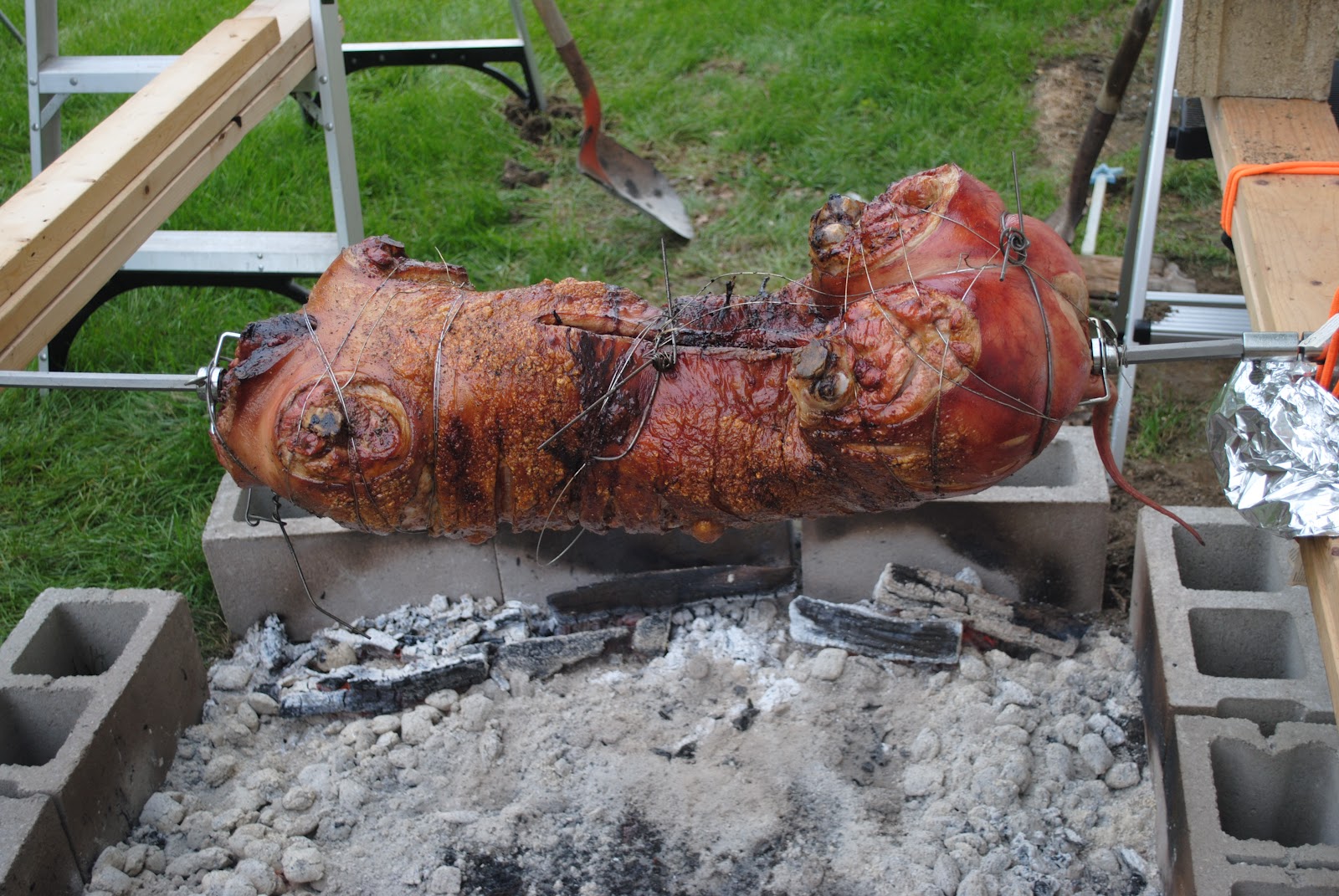
Local pig on a local spit. He wouldn't fit so I had to saw off his local head.

I find that even in circles where many so-called progressive ideas are embraced there is widespread skepticism for what is perceived as the local food movement.

The thrust of such opposition seems to be that if everyone tried to eat exclusively that way, we would all starve. Now, that may well be true. But it does not follow that no one should prefer certain kinds of local food ever. Maybe some people really are advocating the former idea, but I have not met them, and I certainly do not advocate it myself. Nevertheless I do think there are good reasons to prefer local food.

First, freshness. Fresher food tastes better and is better for you. It's easier for fresh food to travel 60 miles and stay fresh than if it travels 6,000 miles. It can be picked later and thus ripen on the vine rather than in a barge.

Second, roots. Eating local gives you some idea of the region you live in, its history and climate and fauna. I now know that great strawberries come from Pennsylvania, while great mangoes do not. That makes me want to eat our strawberries more; when I do so it makes me feel like a Pennsylvanian fed by tradition and my homeland rather than an abstract citizen of the world fed by reductionism and nowhere. Moreover by doing so I continue the collective memory that has existed for generations rather than losing it to a sea of utilitarian pragmatism.

Third, variety. Food produced for global consumption must prioritize hardiness and usually cosmetic factors like color and volume. But smaller-scale production allows for finer-grained choices with different constraints. Tasty heirloom varieties that would never succeed on that stage can be delightfully embraced on the local scale.

Fourth, resilience. The extreme of comparative advantage may be the route to the highest theoretical yield, but there is a tradeoff between optimization and brittleness. A region that produces some of its own food is less subject to the vagaries of the global market. A drought in central Asia or an inexplicable decision by another country to turn its food calories into fuel calories does not change the local tomato yield.

Fifth, accountability. The feedback loop between me and a farmer I buy from, or even that farmer's middleman, is a lot tighter than with the global system. In the latter case I have no chance of affecting any change; in the former I actually have a decent shot.

What makes me sad about knee-jerk anti-local arguments is the grim resignation toward a life of bland drudgery at the dinner table they imply. Whatever the downsides of the global system, it is said, it is the only chance we have of feeding everybody. A world with seven billion and counting people does not have the luxury of participating in the pleasures of traditional food production and consumption. We have already exceeded the global carrying capacity by so much that we must optimize the system as much as possible, or everyone. will. starve.

If that were the case it would be tragic, as tragic as never hearing birdsong again because we took all of their habitats or needing to wear heavy clothes in the summer because we destroyed the ozone layer. It is positively dystopian, and such eventualities should not be blithely accepted. At the least, those who can afford to choose otherwise should be free to.

All of that said, I have yet to participate in the most-local, least-efficient method of food production of all: gardening. Boy would I like to.

Monday, July 23, 2012

Means of Grace


At church I serve on the communion team. Communion, also known as the Lord's Supper or the Eucharist, is a ritual instituted by Jesus during the Passover meal with his disciples on the night he was arrested. He broke bread for them and told them it was his body given for them. Then he took a cup of wine and told them it was the new covenant in his blood, concluding, "Do this, as often as you drink it, in remembrance of me" (1 Corinthians 11:25).

So that's what we do, every Sunday. Every third week or so I serve. That means arriving early and tearing loaves of bread into bitesized portions and pouring wine and grape juice into lots of tiny little plastic cups set in trays. After the sermon we bring the trays up to the front and set them on the table. The pastor institutes the sacrament and then we stand at the front with the food as the church files past, telling each man, woman and child that this is "the body of Christ, broken for you," and "the blood of Christ, shed for you."

The small portions may be a little silly, but they mean that everyone can partake in the meal at the same time (followed immediately by the clink of a hundred plastic cups being set down). Then the pastor prays, we sing a song, we're blessed, and that's it. We on the team clean up the supplies and put them away for the next week.

Sometimes we do special things for the bread. Lately the first Sunday of every month we pray for another country specifically, and to go along with that we eat the bread of that nation. Sometimes too people in the congregation bake the bread, as I like to do being a hobbyist baker myself.

The precise nature of what happens at Communion can be hard to pin down, and different Christian groups hold different ideas. Roman Catholics and similar groups hold that the elements of bread and wine literally become the body and blood of Christ. On the other side, some groups of more recent vintage hold the elements are merely symbols intended to call Jesus to remembrance. The Reformed tradition in which my church stands holds a yet different idea. We believe the bread and wine are really just bread and wine, and yet that in their giving we truly and literally receive Christ and his grace for forgiveness of sins. God communicates his riches, riches greater than all the world's reserves, to us via these humble items. They are a means of grace.

Our position may seem like a fine distinction to draw but it makes a big difference. That we should receive the King of Glory through such ordinary means highlights that God is not limited; he can convey himself by whatever way he pleases. It also highlights that the initiative is all his and not ours. It is not through riches or feats of strength or moral piety that we reach God, though such a transaction would come naturally to us. Rather it is through the utterly common things around us that he has chosen.

It is also crucial that he is really there for us week after week, caring for us until such time as he shall actually return to claim us. We say during the ritual not only that "Christ has died," but also that "Christ is risen" and "Christ will come again." A mere memorial of his death will not suffice.

For today's bread I followed Jeffrey Hamelman's instructions for pain rustique, a French name for a simple bread. Indeed it requires no ingredients other than flour, water, salt, and a little bit of yeast. As is unfortunately my wont I arrived late to set up, and I was greeted by a small tide of nervous energy due to the delay I caused. In response I opened up the plastic bag and released a different kind of wave, the creamy aroma of the still-cooling loaves. As we tore them into pieces others came by the table to take in the smell, and one of us joked that we didn't need to tear everything up, that we could eat some of it now. We did, prompting others to come over and share.

As we cleaned up after the service we munched on extra bread in the back room. An older gentleman on the tear-down team named Bob asked if he could have some, and we gave him half of the small loaf that the pastor breaks in front of the congregation. He sat and ate it, and he marveled, saying "This bread is just so good. Does anyone know where it came from?"

"Well, yes," I said. "I made it."

"Get out of here."

"Really, I did. There's nothing special in it."

Bob had the rest of his bread in silence, and then even some more of the remaining fragments. On his way out he thanked me as the rest of us continued eating while washing, drying, and sipping wine from the little cups.

My takeaway from the experience was not that I must be a great baker. As the baker, I know that is not true. There is nothing special in the bread, and nothing special in preparing it. The ingenuity belongs to Hamelman and to centuries of European bakers. It is freely available. What amazed me was that despite the common nature of the ingredients and the practices, that the flour and the books are just sitting on shelves waiting to be made much of, my bread was received as something wondrously new or rare, as an awakening to taste buds that did not know they had missed it.

Even in a land of abundance such as our own there is a famine for true bread, though it is for anyone, anytime, for the asking and for the taking. It is truly common. Nothing need prevent all from having it.

Such is the bread of heaven.

Saturday, September 4, 2010

Authenticity Revisited

My last post was entitled "Authenticity," yet the word authenticity was nowhere to be found within the message itself. Jonathan called my vagueness to attention and asked for clarification, asking, "Is your complaint here authenticity, or is it quality?"

Indeed, my use of the word begs a definition. I omitted one previously because I could not articulate what I meant, and I hoped that it would be demonstrated by the examples I mentioned. Fortunately, a 17-hour drive to Chicago with Jonathan gave me plenty of time to hash it out.

One observation I had was that before lower-quality versions of the commodities I mentioned existed, no qualifying adjective was needed to describe them. For example, before factory farming methods, eggs did not need to be designated as "pastured" because all eggs were what we now call pastured. The very proliferation of words designating levels of quality betrayed to me a confusion about authenticity resulting from whatever "consumer choice" and "freedom" were won in the process.

Another aspect which puzzled me was the artisan's pursuit of consistency versus the factory's guarantee of standardization. To explain, I will first allow Jeffrey Hamelman from my wonderful bread book to define what I mean by an artisan:
"These days artisan and baker are often combined into one term, as if the unadorned noun baker needs further enhancement...The skilled baker, working with his hands, doing the same work each day, takes his place with the artisans of history...The baker, each day, tries to perfect something that was worked out hundreds of years ago. Mastering the art of fermentation is the ultimate aspiration of the bread baker...When it all goes just right (which it rarely does), and the day's breads have attained more than just good taste, but are, for that day, memorable and charismatic, then the baker knows again why he sets his alarm for that challenging hour."
Bread, Jeffrey Hamelman, John Wiley & Sons 2004.
So an artisan pursues every day the same objective, unchanging standards of perfection, while usually falling short. The best bakers are those who most consistently navigate all of the vagaries of humidity, flour quality, and dough temperature et al (the list is quite long) to produce results close to the standards of their craft.

Here my conundrum presents itself. If consistency is the only value, factories are much better than artisans. With a combination of standardized and interchangeable human and machine labor, they are able to produce nearly identical output. For example, if you have had one Oreo, you have had them all, because they are all the same to an impressive degree. If the best artisans are the most consistent, then are not machines far better than the best artisans?

Intuitively I knew this proposition was false. I realized the crucial difference is uniqueness. Because an Oreo is an Oreo is an Oreo, there is actually no such thing as an Oreo. There is only Oreo, an abstract concept with no particular incarnation. Oreo carries no attachment to anything real, actual, or particular, but only to Nabisco, itself a faceless, rootless, and soulless subsidiary of a multinational corporation.

By contrast, the work of an artisan contains within it something of the artisan himself. I know when I cook that I like very strong flavors with lots of heat. This preference is in accordance with my personality, and so when you eat my food you come to know me in it. Hamelman speaks of a particular day's bread being memorable and charismatic, two things which could never be said of one instance of a standardized product compared to another.

I posit then that authenticity bespeaks two derivative qualities. The first is adherence to objective standards of quality, the same for all instances of the thing produced. The second is specificity, both in that each instance may be distinguished from other instances and thus has its own identity, and that each instance represents the identity of its author.

Factory-produced items may in principle be high quality, but they cannot be authentic. For one, when many contribute to the process, such as when a baking operation is carried out by men who mix separate from men who shape separate from men who bake, the result contains not all of their identities but none of them. For two, factory processes depend on the standardization of every task, depending on no particular man to accomplish them and so by design carry no specificity.

In this way authentic work is like humanity itself. Humans all meet the objective standard of the image of God, yet each is a completely unique work which individually displays the characteristics of his or her creator. It only makes sense that when humans represent the best of their God-given and God-like nature, they create in the same manner as he does.

Tuesday, January 5, 2010

Dare I Bake?

Good things come in threes.

The bread plot deepens.

My dear friend Pat gave me a book of techniques and recipes for baking bread. I had started baking my own whole wheat bread a few months ago. My efforts, though amateur, filled me with delight during many toast mornings and many peanut butter and jelly afternoons. Making yet another decision which isolates me from the supermarket, I have sworn off store bought bread, if I can help it.

With this book I realize I may have started down a road whose destination I scarcely could have perceived. The first sentence I read spoke to sentiments I had already come to cherish in other contexts:
Although modern equipment seeks to duplicate, and thereby nullify, the hard work of the baker, in the actual bakery setting there is no true substitute for skilled hands (66).
Skilled hands! I have written before about longing for manual work with tangible results, even hinting at an inclination for cooking. Author Jeffrey Hamelman continues:
However, for someone aspiring to be an artisan in the historical sense of the word, that is, a skilled manual worker whose hands are integral to the creation of the product, a firm mastery of hand technique is required (66).
The claim that baking bread can connect one to the past, to a mode of being which has been largely forgotten, is exciting. Hamelman also makes it clear that this is skilled labor, not to be learned lightly or in a short period of time, and not to be despised.

Hamelman elaborates by discussing what exactly an artisan is:
One asks, is the baker an artist? An artisan? These days artisan and baker are often combined into one term, as if the unadorned noun baker needs further enhancement. To me, the baker is no artist, for an artist creates something new: This is the domain of poets and painters.

The skilled baker, working with his hands, doing the same work each day, takes his place with the artisans of history: the potters, coopers, carpenters, and smiths. His work may excel and reach toward perfection, but there is little, really, that is new for the bread baker to invent...The baker, each day, tries to perfect something that was worked out hundreds of years ago (86).
In light of that dignified, counter-cultural, and inspiring narrative, dare I bake? Dare I teach these hands to massage something other than a computer keyboard? Dare I meet the ancients at the hearth?

I would sure like to, for several reasons:
  • It seems a more universal skill than any other I possess. A baker can serve anyone, while (say) a programmer is of more limited use. It would be nice to think of returning to South Korea and having something to offer the people other than the English language.
  • It seems an excellent way to connect with my European heritage, since most of these techniques originated there. It would be another way to live as white and redeemed.
  • It seems to connect with other themes of thought which have occupied me in recent years, along the lines of what is lost through industrialization and mass production.
  • It seems an appropriate exploration of masculinity. After all, it was said to the man, "In the sweat of your face you shall eat bread" (Genesis 3:19). Infusing the wheat of the earth with water and air and then tempering it with the fire of the oven - yeah!
  • It seems delicious.
Time will tell if I find the time. If so, I will tell.

Tuesday, December 29, 2009

Golden Breakfast

My kind of color coordination:
Eggs, cheese, honey, orange juice, butter, cornbread.


I have discovered breakfast.

First I discovered eggs, or what eggs should be. It turns out that what you put into an animal affects what comes out of it. Exercise matters too. When a chicken sits still and eats the cheapest food possible, the cheapest eggs possible come out. Those eggs are what you generally find in the supermarket.

Enter pastured eggs. Chickens are given freedom to move around. They eat healthy food, and have freedom to peck at bugs and what-have-you.

Does the result make a difference? Well, is there a difference between the following shades?

Those shades come from a photo I took of a pastured egg yolk with a supermarket egg yolk. The deep orange on top represents the pastured egg. I think it a safe assumption that the difference in color corresponds to a difference of nutrient content.

That's not the only difference. I was startled the first time I sought to scramble one of these yolks, because I could actually feel it give back when I pushed on it.

Let me tell you, the flavor speaks volumes more.

Back to breakfast. My housemate and his wife start every day with a spinach and cheese omelet. Culturally this seemed a bit extravagant, so I asked why. They said that, among other reasons, a higher-protein breakfast leaves them fuller longer and helps them have a healthier appetite through the day.

I tried it out, and my experience confirms their words. My old diet of a simple bowl of cereal left me hungry as few as two hours later, while after eating just two eggs with some toast I felt quite full for that same amount of time and not actually hungry for considerably longer.

Those reasons aside, that breakfast is delicious! Taking some time in the morning to treasure cooking and eating is a wonderful ritual. Prizing such luxuries as beauty and flavor and aroma really starts the day off on a good foot.

After all, what you put into an animal affects what you get out of it. If I want to be productive through the day I think I do well to invest time and money and thought into my fuel.

Sunday, November 29, 2009

A Day in Philadelphia for $20

Why is there a British flag hanging in Elfreth's Alley?
Let's call it...a sign of the glory of the First Amendment.

Yesterday I went with my friend Pat, my sister Samantha, and her boyfriend Jace to Philadelphia. Jace is from Maine and had never been here before. He is also studying to be a history teacher. So, we undertook to show him historic Philadelphia, on a budget. Our itinerary:
  • 8:04: Purchase SEPTA "Independence" day pass for $10 each and catch the R5 into 30th St Station.
  • 8:45: In West Philadelphia ("born and raised..."), catch the El to 2nd and Market St.
  • 9:10: Tour Christ Church at 2nd and Arch, birthplace of the Episcopal church. See George Washington's pew, a 300-year-old chandelier, and a 600-year-old baptismal font, among other treasures. Stingily give only $1 of the suggested $3 adult donation.
  • 9:30: Walk through Elfreth's Alley, one of the few preserved colonial streets left in the wake of demolition for Independence Mall and I-95. Price: free.
  • 9:45: Walk past Benjamin Franklin's grave on the way to Independence Hall. Price: Free.
  • 9:50: Get a fresh, fluffy, warm, mustard-drenched pretzel from a food truck. The pretzel is so good it "lives up to Avatar's hype." Price: $0.50
  • 9:55: Reach Independence Hall looking for tour tickets, only to discover we must walk a block to the "Independence Visitor's Center" to pick up the tickets. The Center is immensely pointless, a fact made more bitter by the knowledge of the aforementioned demolition of Elfreth's Alley-like neighborhoods in its place. Grudgingly pick up free tickets for the 11:45 tour.
  • 10:00: Stop in and see the Liberty Bell. Have the feeling that the history presented here is to real history as muzak is to music. Nevertheless, the bell is cool. Price: free.
  • 10:15: Stop for another pretzel at another cart. Find the second every bit as delicious as the first. Price: another $0.50.
  • 10:15 Walk to the Second Bank of the United States, and stumble upon an incredible exhibit of portraits of Founding Fathers and their contemporaries. Here is history intelligently and legitimately displayed, as the exhibit tries to explain these folks as products of a movement called the Enlightenment, grouped so as to leave room for visitors to make their own inferences and contextualization. See some really cool paintings. Price: free.
  • 11:30: Return to Independence Hall for tour. Hear excellent tour guide involve the whole group, which included visitors from both coasts, the South, Canada, and France. Price: free.
  • 12:30: Walk to Reading Terminal Market for lunch. Realize there are better times to go than Thanksgiving weekend at peak lunch time. Wait around 45 minutes for a cheesesteak at Spataro's, which proves pretty much worth it. Save money and unnecessary calories by bringing a water bottle from home. Price: $8.
  • 2:15: Walk to City Hall. Explore the tallest masonry building in the world. Find the city's Christmas Village set up in wooden huts on the west side. Meet Germans selling roasted nuts. Find out from the merchant that his group came from Bavaria just for this market and will return two days after Christmas. Share Pat's roasted pecans, which are out of this world. Price: free to me, $4 to Pat.
  • 3:30: Walk through Love Park with the intention of reaching the Franklin Institute.
  • 4:00: Stop in to see the Comcast Center's video wall, and receive 3D glasses for their "Holiday Spectacular" show. Enjoy the beautiful screen, though it is merely a glorified screen saver. Discover exactly how empty Christmas becomes when stripped of its Christian context, as most spectacularly displayed by a children's chorus of "It's the Most Wonderful Time of the Year" for the finale. Price: free.
  • 4:25: Return to Love Park for photos of Sam and Jace under the iconic sign.
  • 4:45: Take the El past the giant clothespin to 5th and South with the intention of dinner at Pietro's and an exploration of the street. Price: free.
  • 5:15: Elect instead to return home for free lasagna from Mom's kitchen. Stop by Carpenter's Hall, site of the First Continental Congress. Price: free.
A wonderful day with a few surprises to boot. Total cost was $10 for SEPTA, $1 for the Christ Church donation, $1 for two pretzels, and $8 for lunch.

$20 for a day packed with history, culture, and delights for the senses in a world class city? Sounds like a great deal to me.

Tuesday, July 1, 2008

Image is in the details.

The logo is a siren. Mistake?

Not being a coffee drinker, I was confused by the sizes at a Starbucks recently. Fortunately, they provide handy examples up front, from which I deduced the following translations:

Tall normally means something is bigger than its peers, but in this case tall means small. Customers ordering a tall are freed from feeling like they are depriving themselves.

Grande
means large. Instead of feeling guilty about indulging, customers can take a caffeinated vacation south of the border. Arriba!

Venti means Supersize. We have learned though from our forebears in the 1990's that Supersize will kill you. So Starbucks had to rename it. Venti is Italian for 20, as in the number of ounces in the drink, or the square root of the caffeine dose.

It's great ideas like these that helped Starbucks open a new location every workday in the 1990's.

Wednesday, March 12, 2008

Biofuel: Starving the World's Poor Since 2007

I don't have many original thoughts to share regarding the headline, so please read what David Warren has to say on the subject:
A scheme to kill off the world’s poor, through starvation, has already been launched on the advice of environmental “experts,” and is showing promising results.
...
"Biofuel" is the means. By turning much of the planet’s limited arable land, including especially the lower-cost breadbaskets of the Third World, into grain generators for biofuel, the environmental revolution is creating the conditions for famine on a colossal scale.
Any attempt to use corn to replace or even supplement our supply of petroleum is misguided at best. Proponents hope to capture in our crops amounts of energy rivaling the amount pumped cheaply from the ground in the form of petroleum. The problem is that the amount of energy we get from petroleum is much greater (a gallon of gas contains about 31,000 Calories) than the amount of energy we get from food.*

There is simply no hope of finding enough excess energy in our food supply to shift significantly into our petroleum consumption. We've been trying anyway, and (partially) as a result food prices are climbing worldwide, with results that may prove to be nothing short of devastating.

Biofuels are not a new source of energy. They merely reallocate an old, more valuable source of energy. This is completely backwards, yet it continues to be trumpeted as great progress.

To replace our oil consumption, sources of energy that don't originate in oil must be developed. Nuclear power generates energy from mass (E = mc squared, remember), and we have mass in abundance. The sun radiates more energy to us than we would know what to do with if we could only capture it efficiently. Heck, below the earth's surface geothermal forces move entire continents.

We would be much, much better served in learning to better harvest sources like these, none of which need appreciably emit carbon, if that's what you're worried about. Considering petroleum isn't actually running out at present, there is no need to panic. In likelihood we have a few decades to work things out.

And yes, it would make a lot of sense to stop using oil where we don't need to.

There is much to say on this topic, but for now I'll leave it at this: biofuel is the kind of solution that makes your problem worse, like taking a habanero pepper for heartburn. Except instead of getting indigestion, you make basic nourishment considerably more difficult for billions of people to obtain.

A grave, grave error that should be reversed immediately.

*It's true that to grow our food supply we depend on large amounts of fertilizers derived from fossil fuels. This means it makes even less sense to try to convert crops into fuel, since the way we do things now we are converting fuel into crops to begin with.

Sunday, March 2, 2008

If stomach no smile, heart no smile, and face no smile.

I'm sick. I can't eat much, but I do spend a lot of time in my room fantasizing about foods that I love. Here are some foods that I wish I was eating right now:
  • Eggs benedict
  • Grilled cheese sandwiches
  • Cheeseburgers, from Johnny Rockets or Fuddruckers or Blarney Stone or my kitchen or anywhere, really
  • My mom's pizza
  • Even a glass of orange juice
Mmm mmm mmm, all of these foods are so good. Woe is my wishes-it-wasn't-empty-but-doesn't-want-to-be-filled tummy.

Monday, February 4, 2008

Photos of the Week - 1/27-2/2, 2008

A colleague of mine on the blog last semester referred to my style as "taking pictures of things that annoy you." Given gems like this I could see his point.

In any case, I carry my trusty digital camera most places I go, and I take pictures of things which catch my fancy. Here're a few pictures I took last week:

Banana Blues


First, I discovered at Trader Joe's what it means for a banana to be organic: they don't put in any yellow.

I think there's something wrong with an ethic of organic food which still allows for picking completely unripe fruit out of season and shipping it long distance to mock residents of northern climes.

The stuff grown with petrochemical fertilizers wasn't really any yellower, but that's at least what you would expect from industrial produce.


Burger Bonanza

Don't forget the milk. Oh, yeah. Mmm mm. Delicious.

A conversation with my housemate Carlos about his love of fast food led me to indulge in my semi-annual Whopper.

I give the whole experience three and a half out of five stars. First, there's the drive-through. I probably derived most of the enjoyment from nostalgia, but to smell the indistinct Burger King aroma while waiting in the car was delightful. The price was cheap and the service was fast.

The actual Whopper was filled with indistinct Burger King flavor, which for the most part was a good thing. The experience was over quickly, but not altogether unsatisfying. Lots of pickles.

Mostly it was just great to give the middle finger to forces which tell me fast food is a horrible thing and enjoy it for half an hour. I suspect this is what is behind much of Burger King's recent success. They've come out with new sandwiches which take calorie density to unreached heights, and Americans have responded enthusiastically.

Have you seen the recent commercials where they tell Burger King customers they can't have a Whopper? It's an astounding feat that you can make beloved intellectual property out of a cheeseburger. There are essentially the same ingredients in a Whopper as in any other burger, yet I know one when I taste one. I guess it's the indistinct Burger King flavor.

Thinking about it, that happens all across the American foodscape. Chips Ahoy tastes different from Chips Deluxe. Campbell's Chicken Noodle Soup tastes different from Progresso. Somehow value is added by affixing a brand to the commodity in question: you know what you're getting. The soup may not be any good, but at least you know that this can tastes the same as that can. Familiarity breeds comfort.


Bummer Buster

Thanks, Mark. Thanks a lot.

My (Catholic) stepdad heard that I had been turned down by a (wonderful) girl recently, so he put this ad for the priesthood in my bedroom mirror at home.

What a guy, huh? Sometimes a gentle ribbing is much better than straight sympathy. It's great to have an older man who can tell me not to take myself so seriously.

Note that this ad's strategy is to reassure you that life as a priest is preferable to suicide. "Hey, is your life not worth living? You sound like just the kind of man we're looking for!" If I were them, I would set the bar higher.

Saturday, January 26, 2008

Happy Food


I bet your lunch doesn't look like a smiley face with a snorkel mask.

Mine does.