Are bad words bad?
I have been thinking about this question lately. I started a new job a few weeks ago. My teammates use the f-word liberally, which is a change from my last job. Also, my dear friend Zach has debated whether the name for his new blog (welcome to blogging, Zach!) is too colorful after he realized it made it harder for his parents to enjoy it.
I discovered profanity with the rest of my peers in sixth grade, though my first use of it was actually in the home. In a conversation one evening about bad words my uncle, who along with my dad would swear as a matter of course but rarely with vulgarity, asserted that I was a "good boy" and thus did not curse. Surging with the beginnings of adolescence, I tremulously replied "Hell no!"
That year I remember many profanity-laced arguments in the back of the school bus, and from that conversation on I did not hold back when I was alone with my dad. However it was not long before he was unnerved by my sudden coarseness, and he asked me to stop. This request of course shed light on his own practice around me, and prompted a resolve for reform on his part as well.
I found myself in a similar position when I worked as a camp counselor the summer after my freshman year of college. I felt it was of crucial importance that I was the same person in front of my charges that I was after they had gone to bed. Otherwise my persona in front of them was a lie, as was all of my teaching to them, and I had betrayed my boyhood self as well.
This conviction I felt and still feel very strongly. As a rule of thumb, anything that is shameful to do in front of children or in the knowledge of children is shameful, period. How then could I justify profanity? I could not, and I resolved to stop using it.
There are other arguments against swear words. Paradoxically, while they feel the most natural expressions of emotion, because of their versatility they are among the least expressive words. The f-word can be any part of speech and mean almost anything, and therefore in itself it means very little. If the goals of language are expression and communication, then we are better served by thinking a little harder and finding words that convey our meaning more precisely.
You could also argue that a degradation of speech leads to a degradation of thought which leads to a degradation of character.
All of that said, I do not get too upset when people swear around me. For one, I understand the appeal and trust other adults can weigh the pros and cons of their actions. For two, moralistic insistence on such standards can crowd out much more important subjects. Zach himself remembers far too many conversations in his evangelical upbringing about the matter. I consider it ultimately a minor if still important issue. Though I am concerned as the actions of those around me will inevitably influence me to a degree, often it is just not that big of a deal.
And I still curse. Almost always it is under my breath when no one hears me but God, and it slips out in the face of some undesirable surprise or development. In this as in many areas I am unable to hold myself to a standard that I think is good. To be a hypocrite is human, and I should be understanding with others as well as with myself in this regard.
But even such lapses strengthen my conviction that it is good not to curse. I find that doing so makes insignificant things significant, such as when I make running late in the morning out to be a crisis, and significant things insignificant, such as when something as sacred as sex is made into a joke.
May I have no part of it.
Saturday, March 9, 2013


Wednesday, January 16, 2013
Making Friends with Microbes
 |
| This, my first sourdough bread, could be the beginning of a beautiful friendship. |
Are you afraid of animals?
What about plants?
I would not want to be at the mercy of a great white shark, and I never intend to wipe my face with poison ivy. But I have never met anyone who is categorically afraid of either plants or animals. However I cannot say the same for microorganisms, whether bacteria, fungi, or protozoa; it is not uncommon for an adult to express an unqualified aversion to them.
The prototypical pathological beahvior I am thinking of is the compulsive use of Purell hand sanitizer. I want to know how big of a party they threw at Purell headquarters when the H1N1 virus came out a couple of years ago. All of a sudden the dispensers were ubiquitous in public places, the implication being that using Purel was an extra layer of precaution on top of using soap and water when leaving the bathroom. Enter a room, use Purel. You won't get sick that way.
Of course, pathogenic microbes present a serious danger, significantly greater than that presented by predatory animals or poisonous plants. And basic sanitary practices developed in light of our understanding of microbes go a long way toward keeping us alive and healthy well into our old age. But we should not let a few rotten apples ruin our perception of the whole bushel.
The vast majority of microbes we encounter are benign, and we even depend on many in order to live. Bacterial cells within us actually outnumber our own cells by a good margin (they are much smaller), and they help us by assisting in digestion, by keeping the bad guys from getting a foothold, and by who knows what else. So when I think about microbes I think more of the good guys, or at least the indifferent guys, and I actively cultivate (no pun intended) a positive relationship with them. For example, I know this is controversial but rather than cooking the good with the bad in my milk, I buy milk from trusted farmers who take good care of their cows. Then I drink it raw, thinking fondly of the good work the associated bacteria will do in me.
I even keep microbes as pets. While my housemates have a dog abd others keep potted plants, I have on our kitchen counter a little colony of yeast and bacteria. Every morning I feed them some flour and some water and in return every few days they flavor and leaven my bread. I am still getting the hang of it, but I am new to this and all pet ownership is touch and go at first.
I realize that I may be too credulous, and like an owner of a Burmese python my trust may one day come back to bite me. But I would rather not overstep sensible habits like washing my hands with soap and in so doing put myself in opposition to the whole weight of no less than three taxonomic kingdoms.
People are meant to live as part of an ecosystem of flora and fauna, both micro- and mega-, and not as atoms in a sea of sterility. When we attempt to inabit the latter we come out less healthy because our bodies are simply not designed for such a context. What's more we dilute our weaponry when we use it indiscriminately against all things microscopic and not just against the bad guys.
In short, there is a such thing as too much caution when it comes to our invisible and ever-present companions. We have much to gain by acknowledging and cultivating a right relationship with them, even while maintaining proper vigilance against those who would destroy us.
I hate virsuses though. Get me away from viruses. They freak me out.
Monday, November 12, 2012
Getting Around
One of the most general critiques of technologies is that as we come to rely on them, we become more helpless when they fail or we find oursleves without them.
One of the easiest examples is the technology of GPS. With a GPS one is largely spared the burden of ever being lost. The tradeoff is that if one is not careful, one will also lose the joy of knowing one's way around.
I had a stark experience of this downside recently. I was at the doctor's office and I was going next to a third-party facility for routine bloodwork.
Not remembering exactly how far down the road the facility was, I asked the check-out woman for directions. This woman was probably in her sixties and so she has certainly had to get around for many years before GPS was widely available. Nevertheless, she first appeared flustered, then asked if I had a GPS I could enter an address into. I did, so she handed me a flyer with the address circled on it and sent me on my way.
The thing was as I discovered momentarily the place was on the same street a mere two traffic lights farther down. To have entered the address into my phone and waited for it to tell me to go a thousand feet before turning left would have been quite the opposite of thinking.
But that's just the point. With GPS we have essentially outsourced the problem of navigation from our brains to our computers. That has obvious benefits, but the cost of not being able to distinguish simple cases from complex ones or of not building a mental map of our surroundings at all are significant. It is also apparent from this example that just as muscles atrophy from idleness, we can lose faculties we once possessed. I guarantee that twenty years ago that woman could have told me to go down the street two lights and turn left.
The implication is not that GPS is a bad thing that shouldn't be used. Rather, we should be critical in our use of it. I prefer to use it more like a compass, giving me an idea of a route before I set out on a trip and then going back to it if I stray or become uncertain. In the meantime I do my best to follow along with the route, to know where I am and where I am going. Additionally, if I am giving directions, along with just giving an address to be plugged into a computer, to those that will hear it I give an overview of the way.
On a recent trip to San Francisco I was quite gratified to know enough of my way around to be guiding other visitors and driving them around town. I felt like I had more ownership of the place I was visiting and that I understood more what makes it tick. And on a recent trip to Washington D.C. after giving an address to a friend I was glad I called him back and told him the simple directions. As a result I had a stake in his journey and our shared experience started as soon as he left. I felt like we had acheived something special in this day and age.
In both locations I used my phone as a GPS quite frequently. But I feel I was much more its master than it mine. Let us likewise wield all of our tools.
One of the easiest examples is the technology of GPS. With a GPS one is largely spared the burden of ever being lost. The tradeoff is that if one is not careful, one will also lose the joy of knowing one's way around.
I had a stark experience of this downside recently. I was at the doctor's office and I was going next to a third-party facility for routine bloodwork.
Not remembering exactly how far down the road the facility was, I asked the check-out woman for directions. This woman was probably in her sixties and so she has certainly had to get around for many years before GPS was widely available. Nevertheless, she first appeared flustered, then asked if I had a GPS I could enter an address into. I did, so she handed me a flyer with the address circled on it and sent me on my way.
The thing was as I discovered momentarily the place was on the same street a mere two traffic lights farther down. To have entered the address into my phone and waited for it to tell me to go a thousand feet before turning left would have been quite the opposite of thinking.
But that's just the point. With GPS we have essentially outsourced the problem of navigation from our brains to our computers. That has obvious benefits, but the cost of not being able to distinguish simple cases from complex ones or of not building a mental map of our surroundings at all are significant. It is also apparent from this example that just as muscles atrophy from idleness, we can lose faculties we once possessed. I guarantee that twenty years ago that woman could have told me to go down the street two lights and turn left.
The implication is not that GPS is a bad thing that shouldn't be used. Rather, we should be critical in our use of it. I prefer to use it more like a compass, giving me an idea of a route before I set out on a trip and then going back to it if I stray or become uncertain. In the meantime I do my best to follow along with the route, to know where I am and where I am going. Additionally, if I am giving directions, along with just giving an address to be plugged into a computer, to those that will hear it I give an overview of the way.
On a recent trip to San Francisco I was quite gratified to know enough of my way around to be guiding other visitors and driving them around town. I felt like I had more ownership of the place I was visiting and that I understood more what makes it tick. And on a recent trip to Washington D.C. after giving an address to a friend I was glad I called him back and told him the simple directions. As a result I had a stake in his journey and our shared experience started as soon as he left. I felt like we had acheived something special in this day and age.
In both locations I used my phone as a GPS quite frequently. But I feel I was much more its master than it mine. Let us likewise wield all of our tools.
Saturday, August 25, 2012
Snapshot of the Good Life
Part 1 of an n-part series, where n >= 1.

You go to the farmer's market in Clark Park for eggs, those Mennonite eggs that are better than the eggs that cost twice as much. You got a late start and so they don't have any, but they say if you come back at 1:30 there should be a few more cartons.
You can spare 45 minutes and so you wander up the block until you see the Yumtown USA food truck selling sandwiches called "The Joy" and "The Bat out of Hell." It looks good but you decide you'd better not. You sit on a park bench and get out a book.
Two sentences in, you decide you'd better have that sandwich after all. Minutes later you're sitting on the same bench balancing the sandwich's paper carton on your stomach just hoping to drip the sauce and slaw and grease into it and not onto Cliff Lee's shirt.
The sandwich hits the spot but now you've got a problem. Your hands are a mess, you didn't take a napkin, and this is a park. But no sooner have you considered your options than Kristen Hsu walks over with a red wagon in tow. You explain your predicament.
"This is your lucky day," she says. She reaches into her bag and produces the perfect purple damp washcloth. This day could not improve.
Wednesday, August 22, 2012
Locavore
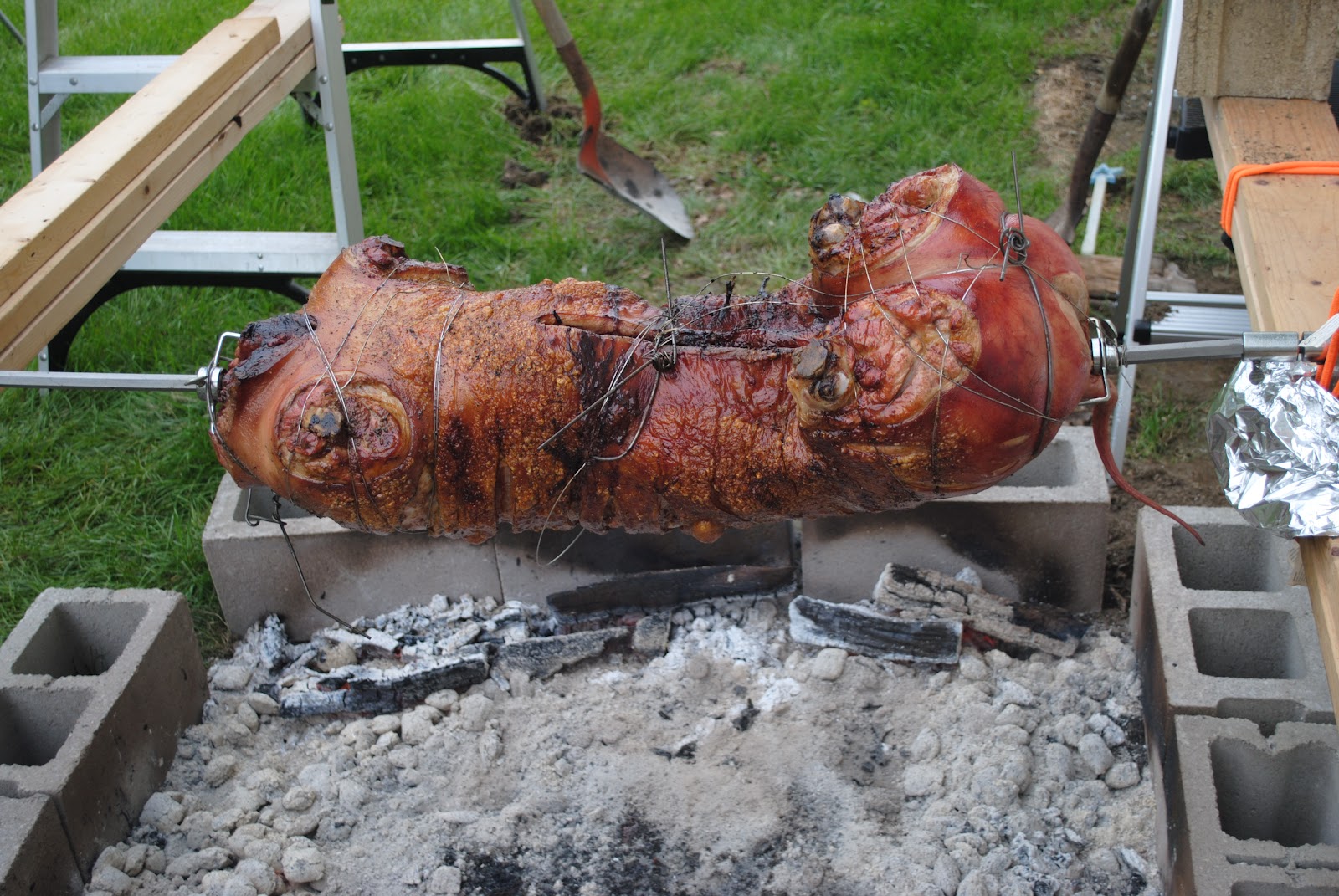 |
| Local pig on a local spit. He wouldn't fit so I had to saw off his local head. |
I find that even in circles where many so-called progressive ideas are embraced there is widespread skepticism for what is perceived as the local food movement.
The thrust of such opposition seems to be that if everyone tried to eat exclusively that way, we would all starve. Now, that may well be true. But it does not follow that no one should prefer certain kinds of local food ever. Maybe some people really are advocating the former idea, but I have not met them, and I certainly do not advocate it myself. Nevertheless I do think there are good reasons to prefer local food.
First, freshness. Fresher food tastes better and is better for you. It's easier for fresh food to travel 60 miles and stay fresh than if it travels 6,000 miles. It can be picked later and thus ripen on the vine rather than in a barge.
Second, roots. Eating local gives you some idea of the region you live in, its history and climate and fauna. I now know that great strawberries come from Pennsylvania, while great mangoes do not. That makes me want to eat our strawberries more; when I do so it makes me feel like a Pennsylvanian fed by tradition and my homeland rather than an abstract citizen of the world fed by reductionism and nowhere. Moreover by doing so I continue the collective memory that has existed for generations rather than losing it to a sea of utilitarian pragmatism.
Third, variety. Food produced for global consumption must prioritize hardiness and usually cosmetic factors like color and volume. But smaller-scale production allows for finer-grained choices with different constraints. Tasty heirloom varieties that would never succeed on that stage can be delightfully embraced on the local scale.
Fourth, resilience. The extreme of comparative advantage may be the route to the highest theoretical yield, but there is a tradeoff between optimization and brittleness. A region that produces some of its own food is less subject to the vagaries of the global market. A drought in central Asia or an inexplicable decision by another country to turn its food calories into fuel calories does not change the local tomato yield.
Fifth, accountability. The feedback loop between me and a farmer I buy from, or even that farmer's middleman, is a lot tighter than with the global system. In the latter case I have no chance of affecting any change; in the former I actually have a decent shot.
What makes me sad about knee-jerk anti-local arguments is the grim resignation toward a life of bland drudgery at the dinner table they imply. Whatever the downsides of the global system, it is said, it is the only chance we have of feeding everybody. A world with seven billion and counting people does not have the luxury of participating in the pleasures of traditional food production and consumption. We have already exceeded the global carrying capacity by so much that we must optimize the system as much as possible, or everyone. will. starve.
If that were the case it would be tragic, as tragic as never hearing birdsong again because we took all of their habitats or needing to wear heavy clothes in the summer because we destroyed the ozone layer. It is positively dystopian, and such eventualities should not be blithely accepted. At the least, those who can afford to choose otherwise should be free to.
All of that said, I have yet to participate in the most-local, least-efficient method of food production of all: gardening. Boy would I like to.
Monday, August 6, 2012
The Parable of the Mice in the Piano
Or, "The Fallacy of Nothing-Buttery."

As related by Mark Potter:

As related by Mark Potter:
There was once a family of mice. They lived in this grand piano. And they had lived there for many generations of mice. Nobody knew that they lived inside the grand piano, but these mice, this family of mice, for many generations had loved living on the inside of the grand piano.
The reason why they loved this so much was because they thrilled to the music of the Grand Musician. They never knew quite when he was going to play but when he would play the mice loved it.
And then one day this intrepid mouse climbed up into a part of the piano where no other mouse had ever dared to go before, and he came back with a report. And he said, "Oh, dear family of mice! My brothers and sisters, aunts and uncles, cousins, mother and father. There is no Grand Musician!
"There are only hammers."
Monday, July 23, 2012
Means of Grace

At church I serve on the communion team. Communion, also known as the Lord's Supper or the Eucharist, is a ritual instituted by Jesus during the Passover meal with his disciples on the night he was arrested. He broke bread for them and told them it was his body given for them. Then he took a cup of wine and told them it was the new covenant in his blood, concluding, "Do this, as often as you drink it, in remembrance of me" (1 Corinthians 11:25).
So that's what we do, every Sunday. Every third week or so I serve. That means arriving early and tearing loaves of bread into bitesized portions and pouring wine and grape juice into lots of tiny little plastic cups set in trays. After the sermon we bring the trays up to the front and set them on the table. The pastor institutes the sacrament and then we stand at the front with the food as the church files past, telling each man, woman and child that this is "the body of Christ, broken for you," and "the blood of Christ, shed for you."
The small portions may be a little silly, but they mean that everyone can partake in the meal at the same time (followed immediately by the clink of a hundred plastic cups being set down). Then the pastor prays, we sing a song, we're blessed, and that's it. We on the team clean up the supplies and put them away for the next week.
Sometimes we do special things for the bread. Lately the first Sunday of every month we pray for another country specifically, and to go along with that we eat the bread of that nation. Sometimes too people in the congregation bake the bread, as I like to do being a hobbyist baker myself.
The precise nature of what happens at Communion can be hard to pin down, and different Christian groups hold different ideas. Roman Catholics and similar groups hold that the elements of bread and wine literally become the body and blood of Christ. On the other side, some groups of more recent vintage hold the elements are merely symbols intended to call Jesus to remembrance. The Reformed tradition in which my church stands holds a yet different idea. We believe the bread and wine are really just bread and wine, and yet that in their giving we truly and literally receive Christ and his grace for forgiveness of sins. God communicates his riches, riches greater than all the world's reserves, to us via these humble items. They are a means of grace.
Our position may seem like a fine distinction to draw but it makes a big difference. That we should receive the King of Glory through such ordinary means highlights that God is not limited; he can convey himself by whatever way he pleases. It also highlights that the initiative is all his and not ours. It is not through riches or feats of strength or moral piety that we reach God, though such a transaction would come naturally to us. Rather it is through the utterly common things around us that he has chosen.
It is also crucial that he is really there for us week after week, caring for us until such time as he shall actually return to claim us. We say during the ritual not only that "Christ has died," but also that "Christ is risen" and "Christ will come again." A mere memorial of his death will not suffice.
For today's bread I followed Jeffrey Hamelman's instructions for pain rustique, a French name for a simple bread. Indeed it requires no ingredients other than flour, water, salt, and a little bit of yeast. As is unfortunately my wont I arrived late to set up, and I was greeted by a small tide of nervous energy due to the delay I caused. In response I opened up the plastic bag and released a different kind of wave, the creamy aroma of the still-cooling loaves. As we tore them into pieces others came by the table to take in the smell, and one of us joked that we didn't need to tear everything up, that we could eat some of it now. We did, prompting others to come over and share.
As we cleaned up after the service we munched on extra bread in the back room. An older gentleman on the tear-down team named Bob asked if he could have some, and we gave him half of the small loaf that the pastor breaks in front of the congregation. He sat and ate it, and he marveled, saying "This bread is just so good. Does anyone know where it came from?"
"Well, yes," I said. "I made it."
"Get out of here."
"Really, I did. There's nothing special in it."
Bob had the rest of his bread in silence, and then even some more of the remaining fragments. On his way out he thanked me as the rest of us continued eating while washing, drying, and sipping wine from the little cups.
My takeaway from the experience was not that I must be a great baker. As the baker, I know that is not true. There is nothing special in the bread, and nothing special in preparing it. The ingenuity belongs to Hamelman and to centuries of European bakers. It is freely available. What amazed me was that despite the common nature of the ingredients and the practices, that the flour and the books are just sitting on shelves waiting to be made much of, my bread was received as something wondrously new or rare, as an awakening to taste buds that did not know they had missed it.
Even in a land of abundance such as our own there is a famine for true bread, though it is for anyone, anytime, for the asking and for the taking. It is truly common. Nothing need prevent all from having it.
Such is the bread of heaven.
Subscribe to:
Posts (Atom)